Showing posts sorted by relevance for query color. Sort by date Show all posts

Tuesday, June 10, 2014

4/C & Then Some :)

Nature and it's inherent connect to tech never ceases to amaze. Back in the day, yours truly was a corporate identity designer using 4/C printing (CYMK - Cyan, Yellow, Magenta & Black/K - used to enhance the printing process) to produce annual reports and ad supplements for companies as CYMK enables printers to recreate the full color spectrum without issue whether the print process be inkjet, offset or rotogravure. Correspondingly, as described in the Physorg piece, four colors were also used by cartographers because...


Now it appears researchers use the same centuries old approach to manipulating color to better understand the nature of crystals.


Seen below is the RGB (Additive colors - used for video) and CYMK (Subtractive colors used for print) diagram set showing how colors interact to generate the full color set populating every image output device known to man. Note: K - Black is always used in quality printing as subtractive inks are "dirty", thus requiring black to enhance the printing process. :)


Sunday, September 07, 2008

Modularity

Nature is economical. For example, Red, Green & Blue (the three primary/additive colors - light) generate all the colors of the rainbow in TVs, projectors & computer displays while Cyan, Magenta & Yellow (three subtractive colors - ink/paint) do the same thing on paper, canvas or anything else that reflects color. (Black is added to the mix as subtractive colors cannot interact with each other as precisely as additive i.e. CYMK/4 Color Process Color Model.)

In additive color models such as RGB, white is the “additive” combination of all primary colored lights, while black is the absence of light. In the CMYK model, it is just the opposite: white is the natural color of the paper or other background, while black results from a full combination of colored inks.

This kind of elegant economy is also expressed in chemistry with the Periodic Table of Elements, a brilliant concept invented by Dmitry I. Mendeleyev in 1869 to show how the elements relate to one another.

In viewing how the elements work as a system, researchers are now questioning if 68 molecules hold the key to all disease, a finding, if found to be true, could be the breakthrough scientists have been looking for since the beginning of time.

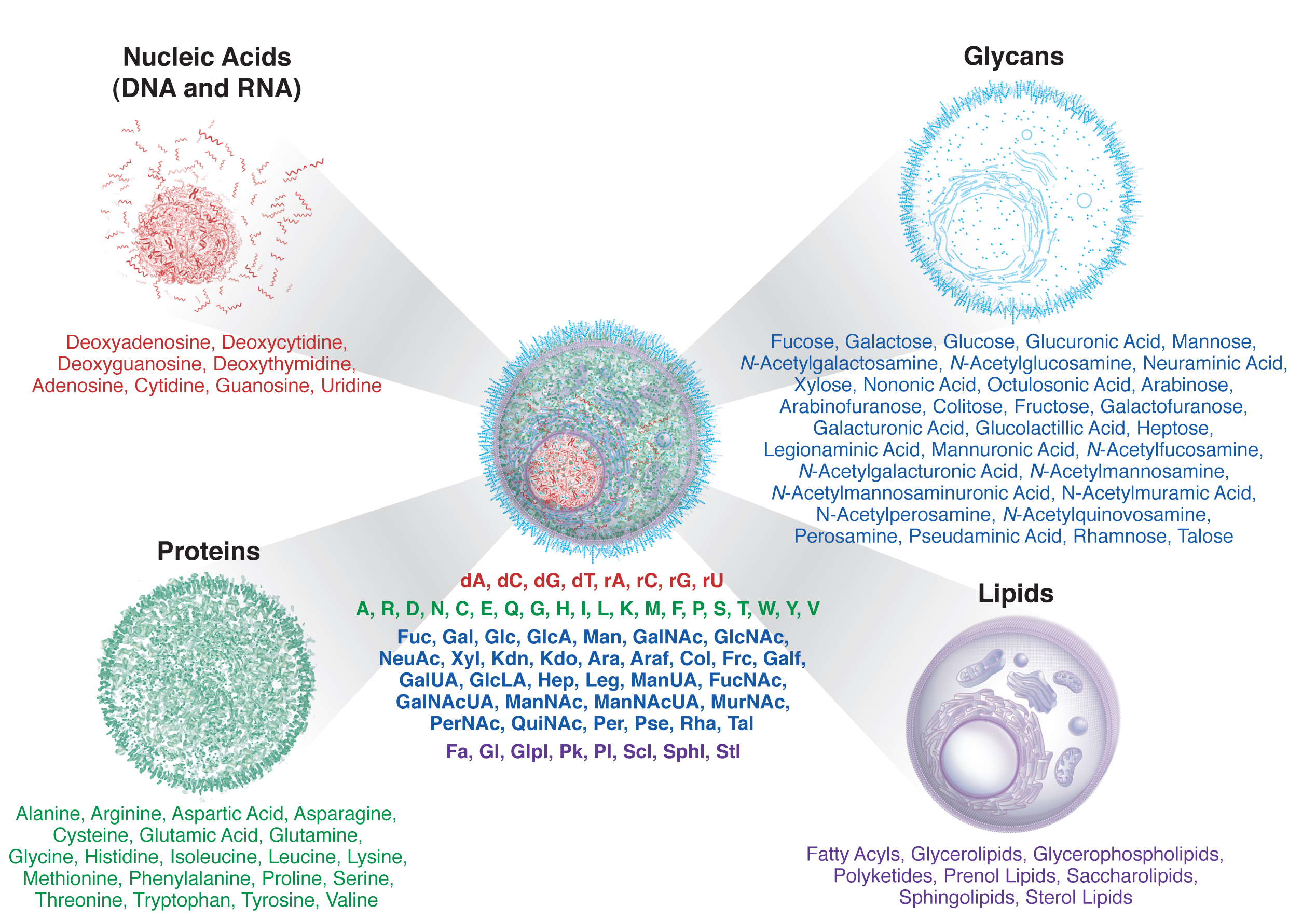
Reviewing findings from multiple disciplines, Jamey Marth, Ph.D., UC San Diego Professor of Cellular and Molecular Medicine and Investigator with the Howard Hughes Medical Institute, realized that only 68 molecular building blocks are used to construct these four fundamental components of cells: the nucleic acids (DNA and RNA), proteins, glycans and lipids. His work, which illustrates the primary composition of all cells, is published in the September issue of Nature Cell Biology.

Like the periodic table of elements, first published in 1869 by Russian chemist Dmitri Mendeleev, is to chemistry, Marth’s visual metaphor offers a new framework for biologists.

Wednesday, June 25, 2008

True Colors

"If people say, ‘What kitsch,’ it annoys me but I’m not surprised,” says Brinkmann, who, with his wife, archaeologist Ulrike Koch-Brinkmann, colored this reconstruction of the c.550 B.C., “Lion from Loutraki.”

"A replica of a stele erected c. 510 B.C. on the grave of the Greek warrior, Aristion, commemorates his exploits in battle. He is dressed in yellow bronze or leather armor, a blue helmet (part of which is missing), and matching blue shinguards trimmed in yellow."

Absolutely a great article from Smithsonian Magazine where one learns the ancient Greeks were into color big time, something that would have changed the look of art forever had the pigments stayed on the great statues and buildings the Greeks had created from the 6Th - 2Nd centuries BC. One fascinating tidbit from the article was a passage scholars missed on how just important the Greeks felt about color on their masterpieces.

"My life and fortunes are a monstrosity, Partly because of Hera, partly because of my beauty. If only I could shed my beauty and assume an uglier aspect The way you would wipe color off a statue."

Helen of Troy - Euripides

What's amazing about this is (after the shock wears off that white was NOT the look of Greek art) is the reality of light and color in Greece as bright sun added to blue sky & deep blue sea gives a pretty good notion that color was an essential component to their culture and... "Vinzenz Brinkmann insists his eye-popping reproductions of ancient Greek sculptures are right on target."

The “Alexander Sarcophagus” (c. 320 B.C.), was found in the royal necropolis of the Phoenician city of Sidon.

After looking at the images, one must admit the colors rock and the look does too.

Now just imagine how colorful the Parthenon was... and yes, modernity lives on in spite of the fact it began over 2600 years ago.

Saturday, September 09, 2017

Linear Moves +


Ultra closeup of Saturn's rings reveal linear lines of great delicacy and subtle gradations of color based on greys, tans and blacks. Stellar imagery but that's par for the course for Cassini, the little probe that can.

These are the highest-resolution color images of any part of Saturn's rings, to date, showing a portion of the inner-central part of the planet's B Ring. The view is a mosaic of two images that show a region that lies between 61,300 and 65,600 miles (98,600 and 105,500 kilometers) from Saturn's center.

The first image (Figure A, above) is a natural color composite, created using images taken with red, green and blue spectral filters. The pale tan color is generally not perceptible with the naked eye in telescope views, especially given that Saturn has a similar hue.

This image was taken on July 6, 2017, with the Cassini spacecraft narrow-angle camera. The image was acquired on the sunlit side of the rings from a distance of 47,000 miles (76,000 kilometers) away from the area pictured. The image scale is about 2 miles (3 kilometers) per pixel. The phase angle, or sun-ring-spacecraft angle, is 90 degrees.


A beautiful simulation based on Saturns rather amazing rings.

Specially designed Cassini orbits place Earth and Cassini on opposite sides of Saturn's rings, a geometry known as occultation. Cassini conducted the first radio occultation observation of Saturn's rings on May 3, 2005.

Three simultaneous radio signals of 0.94, 3.6, and 13 centimeter wavelengths (Ka-, X-, and S-bands) were sent from Cassini through the rings to Earth. The observed change of each signal as Cassini moved behind the rings provided a profile of the distribution of ring material as a function of distance from Saturn, or an optical depth profile.

This simulated image was constructed from the measured optical depth profiles. It depicts the observed ring structure at about 10 kilometers (6 miles) in resolution. Color is used to represent information about ring particle sizes in different regions based on the measured effects of the three radio signals.

Cassine, yours truly will miss you big time.

Friday, June 14, 2019

Up close & personal :)


Up close & personal, Cassini captures the inner workings of Saturn's rings in imagery both astounding and mysterious to a fault. 

To whit.


Cassini, the little probe that could. RIP.

Friday, September 25, 2015

Competency+


The competency of NASA never ceases to amaze, particularly regarding New Horizons
and it's rendezvous with Pluto. Astounding to say the least.

The newest high-resolution images of Pluto from NASA’s New Horizons are both dazzling and mystifying, revealing a multitude of previously unseen topographic and compositional details.

One image, showing an area on Pluto’s best-mapped hemisphere near the line that separates day from night, captures a vast rippling landscape of strange, aligned linear ridges that has astonished New Horizons team members.

“It’s a unique and perplexing landscape stretching over hundreds of miles,” says William McKinnon, a New Horizons Geology, Geophysics and Imaging (GGI) team deputy lead from Washington University in St. Louis. “It looks more like tree bark or dragon scales than geology. This’ll really take time to figure out; maybe it’s some combination of internal tectonic forces and ice sublimation driven by Pluto’s faint sunlight.”

The “snakeskin” image of Pluto’s surface is just one tantalizing piece of data New Horizons sent back in recent days. The spacecraft also captured the highest-resolution color view yet of Pluto – along with detailed spectral maps and other high-resolution images.

The new “extended color” view of Pluto – taken by New Horizons’ wide-angle Ralph/Multispectral Visual Imaging Camera (MVIC) on July 14 and downlinked to Earth on Sept. 19 – shows the extraordinarily rich color palette of Pluto.

Seen below is the snakeskin image of Planet Pluto. :)


Wednesday, July 05, 2023

Winemaking 101


My knowledge of wine is less than 0 as my wife knows far more about this arcane craft than I though I like dry reds better than dry whites, which compromises my depth of understanding of a discipline that's been around for thousands of years.

The reason for this blurb is the fact Alex Halberstadt knows how to write. Fluid, direct and passionate, yours truly came away impressed with his take on a fanatical wine making genius by the name of Maggie Harrison in his NYTimes piece titled Maggie Harrison's War on Wine. 


You gotta love the name of her pinot noir, my favorite wine to drink without question. :)


One reason as to why she's so good at what she does ...


Read Halberstadt's article in it's entirety to learn why wine and Harrison matters. :)

Thursday, November 27, 2014

On the Notion of Rainbows


BRT has talked often about how language defines our notion of reality based on how said language is constructed, whether it be pictographic like Chinese and Japanese or modular like English or Russian. To that end, a good friend of mine posted an awesome link showing how English differs from Chinese when it comes to color, a most important aspect of describing reality without question.

Here's a fascinating visualization (seen above) created by Muyueh Lee that shows the differences between how the English language and Chinese language each describe colors. On the left, you can see the number of English names for color hues (there's a lot!) and on the right, the number of Chinese names (there's a little!).

Shown below is a dataset depicting specific breakdowns of color descriptions.

This is English


This is Chinese


Interesting, eh?

To see how this works in interactive 3D, Muyueh Lee's amazing site is the place to go as the interrelational aspects of just how deep this finding goes is truly astounding.

To yours truly, the notion that language describes our take on reality rings true as shown by Lee's incredibly creative and innovative research.

PS. Thanks Mark for turning me onto this. :)


Sunday, July 02, 2023

Beyond computation ...

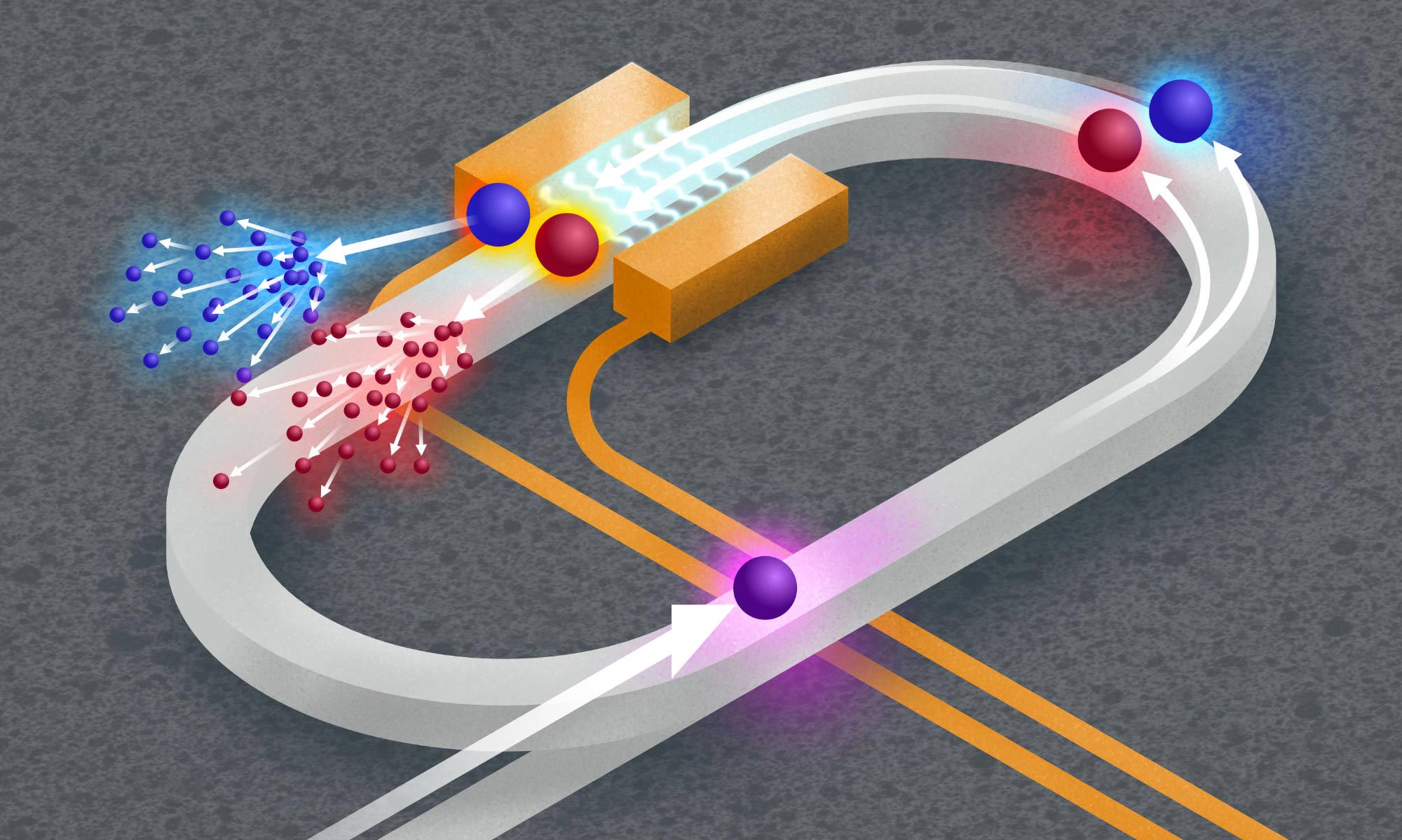
 Synthetic Space Quantum Simulator Model

A new system developed by researchers at the University of Rochester allows them to conduct quantum simulations in a synthetic space that mimics the physical world by controlling the frequency, or color, of quantum entangled photons as time elapses.
Credit: University of Rochester illustration / Michael Osadciw

Everybody talks about quantum computing from the code-breaking and factoring side of things due to the fact the compute power of said systems goes beyond computation because qubits can be 0s AND 1s at the same time, thus exponentially increasing the ability to solve difficult problems beyond the kin of serial processing via bits - 0s OR 1s, the way every non-QC system in the world crunches data. With this said, the real power of QC may be its ability to recreate reality in finite space, a concept discussed in detail by Seth Lloyd in his seminal book titled Programming the Universe.


Recreating reality was just a conjecture, until now.

Friday, November 06, 2015

Fall 2015/Light/Color & Image


Fall 2015 was spectacular due to the perfect combination of rain/sun/heat & cold needed to amp up the transition from all green to all shades of green plus yellows tamping down to browns as NE moved into November.  Hopefully, this video captures, in small part, this most beautiful of seasons with it's take on light, color and imagery. Stellar without question. Enjoy.

Sunday, September 01, 2024

The Eyes have it :)


Yours truly loves jumping spiders. Tiny, inquisitive and incredibly smart, these engaging little guys captivate me to no end while also being an extremely successful predator to the max. The reason for the jumper's skill set is readily seen by this truly excellent clip describing how this amazing arachnid sees the world indirectly connects to the deep relationship of additive and subtractive color spaces as articulated in a "wonderful" series of blurbs residing in BRT under color. :)

Why talk about this? Well, vision is a prime driver of intelligence as it requires serious brain power to negotiate the 3D space in which all life lives. From the development of vision over 540 million years ago in the Cambrian to today, the capability to see was and is essential for almost all life on this planet to survive.


Rev II


In closing ...


the Eyes have it. :)

Jumpers also hear, very well, without question. 


Science, done well, never disappoints. :)

Thursday, December 05, 2024

Stitch by Stitch ...


As stated often in BRT, everything's connected as entanglement, at the most fundamental level, has now been proven to exist when researchers discovered entanglement occurring in protons via quark/gluon interactions. This important discovery may also help show how time emerges as entanglement resides in every sub atomic particle inside every atom in the universe.  How cool is that? :)


Saturday, February 05, 2022

QC's other uses ...


What's curious about quantum systems is the sole focus by the press on said tech being the end-all for breaking encryption instead of discussing why QC would also be perfect for AI-driven neural nets and ray tracing due to the inherent parallelism of qubits being in superposition to enable quantum computers to escape the limitations of serial processing forever.

For Valeria Saggio to boot up the computer in her former Vienna lab, she needed a special crystal, only as big as her fingernail. Saggio would place it gently into a small copper box, a tiny electric oven, which would heat the crystal to 77 degrees Fahrenheit. Then she would switch on a laser to bombard the crystal with a beam of photons.

This crystal, at this precise temperature, would split some of those photons into two photons. One of these would go straight to a light detector, its journey finished; the other would travel into a tiny silicon chip — a quantum computing processor. Miniature instruments on the chip could drive the photon down different paths, but ultimately there were only two outcomes: the right way, and the many wrong ways. Based on the result, her processor could choose another path and try again.

The sequence feels more Rube Goldberg than Windows, but the goal was to have a quantum computer teach itself a task: Find the right way out. For Saggio, a quantum physicist who moved to the Massachusetts Institute of Technology a few weeks ago, the project was akin to sticking a robot in a maze. The computer must learn the right path without any prior knowledge of where to turn along the way. It’s not too hard a chore — a normal classical computer could brute-force its way through dead ends and lucky guesses. But Saggio wondered, “Can quantum mechanics help?” She and her collaborators showed last year that it can.

Crucially, the chip is not just moving through faster cycles of trial-and-error, said Lucas Lamata, a quantum machine learning expert at the University of Seville. “The novelty in this paper is that they show a speedup in learning. [It’s] an important breakthrough.” Quantum mechanics makes the system learn in fewer steps. In that sense, it shows in an experiment what Temme’s theoretical speedup promised: Quantum physics can outwit — not just outrun — classical computing. 

It's all about kernels.


The story of MAGI Mathematical Applications Group Incorporated begins with the “simple” question, “What paths would radiation take when a 20 megaton nuke goes off? Hypothetical target? NYC." 

MAGI was tasked to answer the question by inventing ray tracing to track the radiation paths of the nuke’s blast to the environment but also to apply the same technique to imaging as a nuke is a single energy source like a light bulb and blast and light rays propagate exactly the same but with the difference being light rays nondestructively intersect with objects and react according to the kind of characteristics the objects in question may possess like color, texture, transparency and reflectivity, using the laws of physics to generate an accurate 3D rendering of the scene in question. Computationally intense, ray tracing, and it's even more complex sibling, radiosity, are the most accurate ways to render high-resolution 3D scenes known to science. Note, in reality, rays propagate from light sources to illuminate the scene in question. 

Which means QC would be perfect for this kind of intense image creation without question.


It's only the beginning. :)

Friday, June 27, 2025

The Blue Screen of Death ...


Don't do it, as the BSOD was part and parcel of a demonic methodology designed to enrage MS users to no end when the OS crashed, particularly often when NT ruled the roost. MS, in their infinite wisdom, as far as I can tell, used the B part of the additive color space of RGB to make sure us rubes knew instantly when the OS vapor locked at the worst possible time.


To whit.

Tuesday, January 14, 2025

It seems ...


Well, it seems entanglement may be everywhere now that researchers recently discovered it to exist in the proton with its constituent parts, quarks and gluons, exchanging information instantaneously in similar fashion to electrons and photons, thus proving spooky action at a distance may be the fundamental way reality is stitched together to enable space and time to emerge as needs warrant. 

The neutron awaits ...


Picture two particles that can communicate instantly, regardless of how far apart they are. This phenomenon, known as quantum entanglement, challenges our understanding of how the Universe operates. Once considered a bizarre paradox by Albert Einstein, who referred to it as “spooky action at a distance,” entanglement has been repeatedly demonstrated on a macroscopic scale. More recently, scientists have made a groundbreaking discovery: this peculiar phenomenon also occurs within protons, the fundamental building blocks of matter. This revelation is reshaping our view of the microscopic world and paving the way for new scientific explorations.


The Proton