Showing posts sorted by relevance for query seth lloyd. Sort by date Show all posts

Monday, February 23, 2026

The Contextual Mind


Light shines through - RM/Freepik/Nana Banana

When thinking about quantum computing, the notion of beyond computation comes to mind as it really is beyond computation if you map millions of qubits into a stable medium such as glass. As per Seth Lloyd in Programming the Universe, QCs do just that as they are quantum, analog and, like the Menger Sponge, contain infinities inside a finite space. When room temperature potential is married to quantum systems, simulating reality becomes the norm, not the exception and ... as a result. the contextual mind becomes a distinct possibility.


In his book, Programming the Universe, Lloyd contends that the universe itself is one big quantum computer producing what we see around us, and ourselves, as it runs a cosmic program. According to Lloyd, once we understand the laws of physics completely, we will be able to use small-scale quantum computing to understand the universe completely as well.


To whit 

As per Something Eternal, steps bringing Lloyd's vision to fruition becomes doable
as the theoreticals are in place to make it happen.

Conversing with Gemini
  • Glass Sanctuary (Substrate): Use high-purity glass as the "topological sanctuary," to etch Penrose-Hameroff microtubule lattices directly into the substrate. This provides a stable, room-temperature environment for quantum coherence, replacing the heat and energy waste of current silicon based systems.
  • Voxel-CSG Logic (Architecture): The Universal Modeler (TUM) provides the mathematical scaffolding. By using solid primitives (Union, Difference, Intersection), fabs loft a 3D volume similar to how MRI's work (3D voxels connect MRI slices to generate images of the body) where the model and the object become one entity, eliminating the "Discretization Gap" that plagues polygonal modeling as polygons are but surface entities, devoid of any hard data needed to properly build the synthetic microtubules in situ.
  •  The 137-ID Routing (The Navigator): Every photonic transit within the waveguides is addressed via the Fine Structure Constant (1/137). This ensures the data running through the optical wave guides follow the Principle of Least Action—the most efficient transit nature allows, identical to the efficiency of a cyclist coasting down a hill.
  • Thermodynamic Noise (The Fuel): The system feeds on the analog "jiggling" of atoms. By leveraging Langevin dynamics, we turn thermal noise into the Oxygen of structured data, reducing energy requirements by ten billion times compared to traditional neural networks.
This is a rough cut to make Lloyd's take plausible as the possible emergence of
the contextual mind in relation to AI is no longer consigned to the realm of fantasy.

And so it goes. K. Vonnegut

Thursday, December 01, 2022

It's all wormholes ...

It's all wormholes if the Quanta Magazine piece titled Physicists Create a Wormhole Using a Quantum Computer proves to be true.

To whit. 

Physicists have purportedly created the first-ever wormhole, a kind of tunnel theorized in 1935 by Albert Einstein and Nathan Rosen that leads from one place to another by passing into an extra dimension of space.

The wormhole emerged like a hologram out of quantum bits of information, or “qubits,” stored in tiny superconducting circuits. By manipulating the qubits, the physicists then sent information through the wormhole, they reported today in the journal Nature.

The team, led by Maria Spiropulu of the California Institute of Technology, implemented the novel “wormhole teleportation protocol” using Google’s quantum computer, a device called Sycamore housed at Google Quantum AI in Santa Barbara, California. With this first-of-its-kind “quantum gravity experiment on a chip,” as Spiropulu described it, she and her team beat a competing group of physicists who aim to do wormhole teleportation with IBM and Quantinuum’s quantum computers.

Seth Lloyd is right ...

In his book, Programming the Universe, Lloyd contends that the universe itself is one big quantum computer producing what we see around us, and ourselves, as it runs a cosmic program. According to Lloyd, once we understand the laws of physics completely, we will be able to use small-scale quantum computing to understand the universe completely as well.

And so it goes ... K. Vonnegut

Sunday, December 15, 2024

There is no off ramp :)


Mirror Beach


S = entropy
k_{b} = Boltzmann constant
\ln = natural logarithm
\Omega = number of microscopic configurations

Being rather limited in math to say the least, this "simple" equation explains in a way even I can understand as entropy is the driving engine of the 2nd law of thermodynamics. When paired with the first, the two define reality as being an environment sustained by the ever moving essence of energy.


But it's more than that ...


Heisenberg's Uncertainty Principle & Entropy, a match make in heaven


We will never know everything but you already know that, right? Georg Cantor proved this to be so with infinities residing within infinities using his theory of transfinite numbers to make it happen. The Menger Sponge, seen above, is a 3D representation of Cantor's theory.

In closing ...


Low


High

In closing ...


Everything's connected and entangled, this is why we rubes have a consistent view of a "uncertain" reality we will never fully understand. Awesome to a fault without question if you're one willing to question. :)

And so it goes ... K. Vonnegut

Sunday, July 02, 2023

Beyond computation ...

 Synthetic Space Quantum Simulator Model

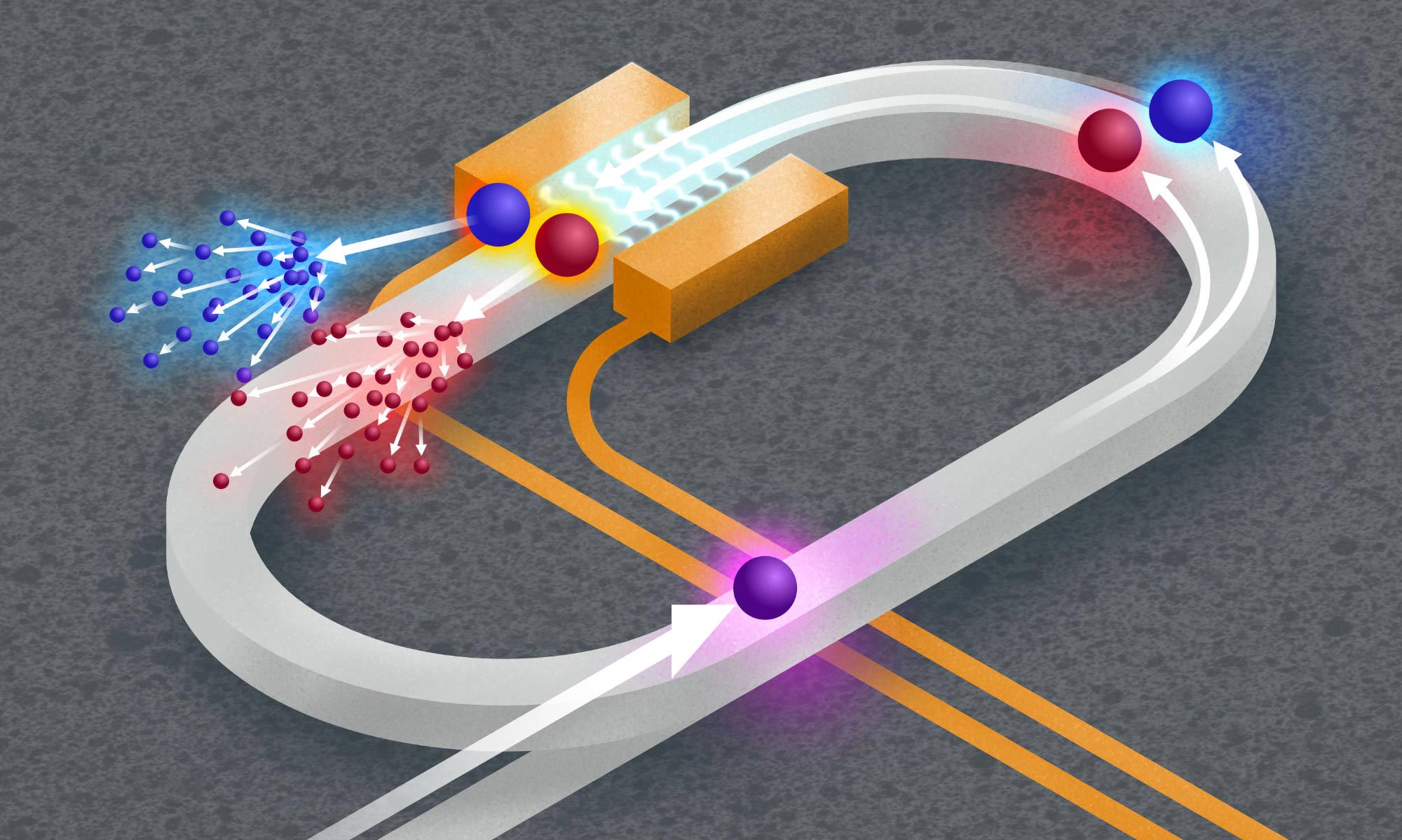
A new system developed by researchers at the University of Rochester allows them to conduct quantum simulations in a synthetic space that mimics the physical world by controlling the frequency, or color, of quantum entangled photons as time elapses.
Credit: University of Rochester illustration / Michael Osadciw

Everybody talks about quantum computing from the code-breaking and factoring side of things due to the fact the compute power of said systems goes beyond computation because qubits can be 0s AND 1s at the same time, thus exponentially increasing the ability to solve difficult problems beyond the kin of serial processing via bits - 0s OR 1s, the way every non-QC system in the world crunches data. With this said, the real power of QC may be its ability to recreate reality in finite space, a concept discussed in detail by Seth Lloyd in his seminal book titled Programming the Universe.


Recreating reality was just a conjecture, until now.

Friday, September 16, 2011

Music of the Spheres


The real power of quantum computing is NOT the ability to crack security codes or to search huge databases at blinding speeds, the real power of quantum computing lies in simulating reality.

"The physicists of the University of Innsbruck and the Institute for Quantum Optics and Quantum Information (IQOQI) in Innsbruck have come considerably closer to their goal to investigate complex phenomena in a model system: They have realized a digital, and therefore, universal quantum simulator in their laboratory, which can, in principle, simulate any physical system efficiently."


Back in 2008, Seth Lloyd, in his eloquent book Programming The Universe, stated the underlying reason why the scientists at Innsbruck were able to do something which, in time, could change the future of man in ways impossible to comprehend.

"Quantum computers process the information stored on individual atoms, electrons, and photons. A quantum computer is a democracy of information: every atom, electron, and photon participates equally in registering and processing information. And this fundamental democracy of information is not confined to quantum computers. All physical systems are at bottom quantum-mechanical, and all physical systems register and process information."

In indirect fashion, The Music of the Spheres seems apropos as man begins to tease information out of reality using photons and atoms just as the ancients used the motion of celestial bodies to tease out harmonic and relational aspects of nature using music as the mechanism to make it happen.

Sunday, February 10, 2013

The Red Pill


In other words, the possibility of the Matrix being real is possible but...on a much vaster scale.


The notion of reality being a simulation is not that startling when John Wheelers's from It to Bit concept is factored into the equation, something BRT has discussed on numerous occasions including Message in a Bottle, a piece incorporating Wheeler's notion that the universe is an information engine along with Seth Lloyd's brilliant take on quantum computing, a device far more powerful then a mere breaker of cryptographic codes residing on the net.

Another aspect of existence most interesting is the fact everything can be digitized and that life, at it's very core, is a 4 part digital environment as DNA consists of 4 nucleotides, (guanine, adenine, thymine, and cytosine) recorded using the letters G, A, T, and C and are always paired as ATCG without exception.


Any questions?

Click here to download Constraints on the Universe as a Numerical Simulation, the amazing research done on cosmic rays. Needless to say, you will not be disappointed. :)


Wednesday, October 06, 2010

Message in a Bottle


I have been fascinated by quantum computers for years, not for secure communications or radically fast number crunching via true parallel processing, but rather by the potential of capturing reality in ways unimagined by any other system known to man. Key to making this happen is the ability to stop, store and manipulate light (i.e. quantum memory) in real time, something thought not possible to achieve, in a practical sense, until now.

"Light entering the crystal is slowed all the way to a stop, where it remains until we let it go again," explains lead researcher Morgan Hedges. "When we do let it go, we get out essentially everything that went in as a three-dimensional hologram, accurate right down to the last photon.

While reading this, one sees how John Wheeler's brilliant concept of It From Bit applies with the notion  information may be the driving engine of existence. (Boltzmann deserves mention here as well.)

What is reality, then? Wheeler answers his own question with the koanlike phrase "it from bit." Wheeler explains the phrase as follows: "Every 'it'—every particle, every field of force, even the spacetime continuum itself—derives its function, its meaning, its very existence entirely—even if in some contexts indirectly—from the apparatus-elicited answers to yes-or-no questions, binary choices, bits."


When added to Seth Lloyd's interpretation, the conversation about reality and quantum computing becomes rather interesting.

  "And what is the entire universe computing, ultimately? “Its own dynamical evolution,” he says. “As the computation proceeds, reality unfolds."

IMHO, man is getting closer to building a reality engine theoretically able to recreate existence in ways akin to the Matrix, a most exciting yet unsettling prospect when viewed against a world filled with violence, intolerance, ignorance and greed.

As for the Message in a Bottle, bit, read below to see if the song applies. To me, in a strange way, it does.

Dr Sellars' team has previously performed an experiment that 'stopped' light in a crystal for over a second, more than 1,000 times longer than was previously possible. He said that the team is now bringing together systems that combine the high efficiency with storage times of hours.


Addendum: The computing part of QC took a big step as solid state error correction now works as seen by research being done at Yale and USCB.


"Light entering the crystal is slowed all the way to a stop, where it In this new study, the team was able to achieve an entangled state by placing the three qubits in a superposition of two possibilities -- all three were either in the 0 state or the 1 state. They were able to attain this entangled state 88 percent of the time.


With the particular entangled state the team achieved, they also demonstrated for the first time the encoding of quantum information from a single qubit into three qubits using a so-called repetition code. "This is the first step towards quantum error correction, which, as in a classical computer, uses the extra qubits to allow the computer to operate correctly even in the presence of occasional errors," Girvin said.


Monday, December 03, 2007

Planet of the Apes

After reading this, perhaps some of the GOP presidential candidates should rethink their opposition to evolution as young chimps are better at math then we are. "No one can imagine that chimpanzees-young chimpanzees at the age of five-have a better performance in a memory task than humans. Here we show for the first time that young chimpanzees have an extraordinary working memory capability for numerical recollection-better than that of human adults tested in the same apparatus, following the same procedure."

Hey, maybe chimps are descended from us. It's certainly more plausible than earth being 6000 years old according to one Archbishop James Ussher. who "published a chronology that purported to time and date Creation to the night preceding October 23, 4004 BC.

Now all we have to find out is if an infinite number of monkeys can type out Hamlet if given enough time. According to Seth Lloyd, the possibility could arise if said monkeys typed on a computer and not a typewriter. Read Programming the Universe to learn why.

Sunday, May 06, 2007

The Fabric of Reality

Back in 1997, David Deutsch, a brilliant British physicist, wrote a book that changed my view of reality by explaining the following concepts in clear prose and illustrative diagrams.

Quantum physics and its many-universes interpretation
The theory of evolution (Darwin/Dawkins)
The theory of computation (quantum computation)
The theory of knowledge (Karl Popper), explanation and understanding

The first pages describing light and how it interacts with other universes shows how the quantum world works, the section covering computing and how it relates to the other three topics opens the door to realizing that the multiverse is real and that quantum computing is nature's way of operating, something one would never realize prior to reading a book such as this. Prior to 2007, the notion of practical quantum computing becoming real was considered to be a thought experiment, something weird and wonderful and beyond the capabilities of tech but that is changing at rates that even amazes Deutch, who is considered to be the father of the QC.

Some of the events making the QC possible.
1. Stopping Light
2. Quantum Wells
3. Adiabatic Quantum Computing
4. Controllable Qubits
5. Seth Lloyd

Time to entering the Age Beyond Computation: Five/Ten years. Impact of same: Unknown.