Showing posts sorted by relevance for query alan turing. Sort by date Show all posts

Tuesday, August 10, 2021

Patterns one & all ...


Back in 1952, Alan Turing discovered chaos when he figured out how patterns in nature emerge using two variables, one to generate the pattern and another to inhibit it, thus giving rise to organic lines or stripes whether they reside on fish, tigers, bacteria or galaxies. Now it seems Turing's equations also work at nano scales as seen by new research dealing with crystals and how they grow on a given surface.

The stripes looked like a mistake.

Several years ago, a team of physicists at Stanford University led by Aharon Kapitulnik was trying to grow a thin layer of bismuth crystal on a metallic surface. But instead of forming a uniform sheet, the crystal became a patchwork of uneven growth. In some areas — those where the crystal layer was only one atom thick — a striking design emerged. Small stripes filled up irregular patches, and these regions butted against one another, their stripes oriented at different angles.

Kapitulnik couldn’t explain the stripes. Then on a working trip to Paris in 2017, he showed them to Yuki Fuseya, a theorist at the University of Electro-Communications in Chofu, Japan. “This is like a zebra,” Fuseya told Kapitulnik. And if the stripes were really like a zebra’s, he said, they could be a Turing pattern.

The possibility came as a surprise. Countless patterns in nature, from zebra stripes to psychedelic hallucinations and windswept ripples in sand, are thought to stem from a mechanism that Alan Turing proposed in 1952, between his famed code-breaking work during World War II and his tragic death in 1954. This kind of pattern has since been identified in the arrangement of bacteria, stripes on sea shells, and even the distribution of human settlements. This ever-growing list includes systems on vastly different scales, from embryos to galaxies.

The Turing pattern ...

The Turing pattern is a concept introduced by English mathematician Alan Turing in a 1952 paper titled "The Chemical Basis of Morphogenesis" which describes how patterns in nature, such as stripes and spots, can arise naturally and autonomously from a homogeneous, uniform state.[1] In his classic paper, Turing examined the behaviour of a system in which two diffusible substances interact with each other, and found that such a system is able to generate a spatially periodic pattern even from a random or almost uniform initial condition.[2] Turing hypothesized that the resulting wavelike patterns are the chemical basis of morphogenesis.[2]


They're everywhere ...


Astounding says it all.

Thursday, March 25, 2021

It's about time ...


Alan Turing finally gets his due, this time, not only his picture but also several easter eggs, commemorating a visionary years ahead of his time, on England's upcoming 50 Pound note. Said note will be issued June 23rd on Alan Turing's B' Day. Awesome.

Wednesday, October 29, 2025

Existence is analog with digital override ...


A 2021 quote by yours truly ... Back in 1952, Alan Turing discovered chaos when he figured out how patterns in nature emerge using two variables, one to generate the pattern and another to inhibit it, thus giving rise to organic lines or stripes whether they reside on fish, tigers, bacteria or galaxies. Now it seems Turing's equations also work at nano scales as seen by new research dealing with crystals and how they grow on a given surface.


It gets better. :)

Friday, January 20, 2023

Idea Dynamos ...

 A 1923 cartoon by H.T. Webster captioned "In the year 2023 when all our work is done by electricity."

illustrates, in eerie fashion, what is happening today in the guise of AI writ large.  

In 1923, an editorial cartoonist named H.T. Webster drew a humorous cartoon for the New York World newspaper depicting a fictional 2023 machine that would generate ideas and draw them as cartoons automatically. It presaged recent advancements in AI image synthesis, one century later, that actually can create artwork automatically.

 The vintage cartoon carries the caption "In the year 2023 when all our work is done by electricity." It depicts a cartoonist standing by his drawing table and making plans for social events while an "idea dynamo" generates ideas and a "cartoon dynamo" renders the artwork.

In 2025 ...

In an interview with Yahoo Finance Live, author Nina Shick claims that generative AI, like as Open AI’s DALL-E and ChatGPT could completely change how digital content is developed in the next three years.

“I think we might reach 90 percent of online content generated by AI by 2025, so this technology is exponential,” Schick, who is an advisor and expert in Generative AI, tells Yahoo Finance Live.

Which means ...

With Stable Diffusion, you may never believe what you see online again

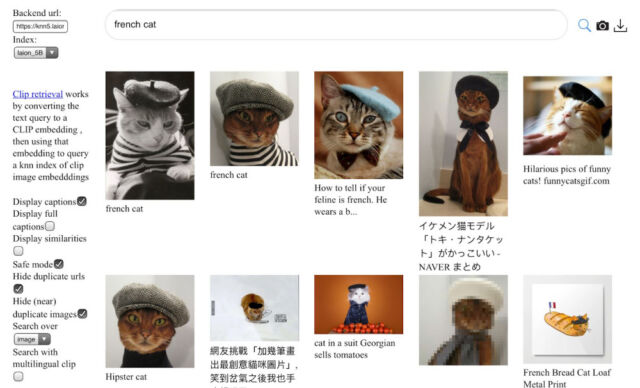
The LAION-5B image set contains 5.85 billion CLIP-filtered image-text pairs scraped from the Internet.

The LAION-5B image set contains 5.85 billion CLIP-filtered image-text pairs scraped from the Internet.

As for the Turing Test ...

Ricardo Rey

Franz Broseph seemed like any other Diplomacy player to Claes de Graaff. The handle was a joke — the Austrian emperor Franz Joseph I reborn as an online bro — but that was the kind of humor that people who play Diplomacy tend to enjoy. The game is a classic, beloved by the likes of John F. Kennedy and Henry Kissinger, combining military strategy with political intrigue as it recreates the First World War: Players negotiate with allies, enemies and everyone in between as they plan how their armies will move across 20th-century Europe.

When Franz Broseph joined a 20-player online tournament at the end of August, he wooed other players, lying to them and ultimately betraying them. He finished in first place.

Mr. de Graaff, a chemist living in the Netherlands, finished fifth. He had spent nearly 10 years playing Diplomacy, both online and at face-to-face tournaments across the globe. He did not realize until it was revealed several weeks later that he had lost to a machine. Franz Broseph was a bot.

“I was flabbergasted,” Mr. de Graaff, 36, said. “It seemed so genuine — so lifelike. It could read my texts and converse with me and make plans that were mutually beneficial — that would allow both of us to get ahead. It also lied to me and betrayed me, like top players frequently do.”

Built by a team of artificial intelligence researchers from the tech giant Meta, the Massachusetts Institute of Technology and other prominent universities, Franz Broseph is among the new wave of online chatbots that are rapidly moving machines into new territory.

In essence, as stated before in BRT, we have lost control. 

“Machines take me by surprise with great frequency.  This is largely because I do notdo sufficient calculation to decide what to expect them to do.”Alan Turing (1950), Computing Machinery and Intelligence, Mind, 59, 433-4601.

Alan Turing Aged 16.jpg

Alan Turing, a British mathematician, proposed in 1950 that the test of machine intelligence would be an ability to conduct a conversation in an indistinguishably human way.Credit...Archivio GBB, via Alamy

Monday, January 18, 2010

Limits of Knowledge

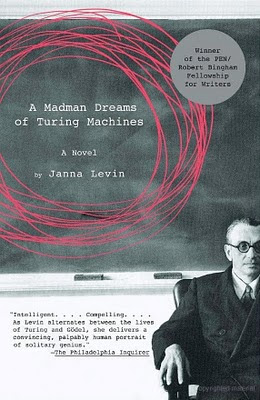
Just finished a terrific book about Alan Turing and Kurt Godel titled A Madman Dreams of Turning Machines by Janna Levin, a work, acting as catalyst, encourages one to think about computability, incompleteness and uncertainty, three concepts defined by Turing, Godel and Werner Heisenberg, which, in every way imaginable, has changed man's view of reality forever.

Alan Turing, the seminal genius who rightfully can be called the father of computing and Artificial Intelligence, articulated the premise of computability via the Universal Turing Machine, the predecessor to all things digital and AI.


Kurt Godel, the sly, paranoid logician, formally proved truth and provability forever reside in different domains...

"The proof of Gödel's Incompleteness Theorem is so simple, and so sneaky, that it is almost embarassing to relate. His basic procedure is as follows:


As for Werner Heisenberg, his Uncertainty Principle proves that man's ability to truly see all aspects of reality will remain beyond his reach until the end of time.

"In quantum mechanics, the Heisenberg uncertainty principle states that certain pairs of physical properties, like position and momentum, cannot both be known to arbitrary precision. That is, the more precisely one property is known, the less precisely the other can be known. This statement has been interpreted in two different ways. According to Heisenberg its meaning is that it is impossible to determine simultaneously both the position and velocity of an electron or any other particle with any great degree of accuracy or certainty."

"One must know one's limitations." - Dirty Harry

Thursday, August 17, 2023

The limits of knowledge/rev X


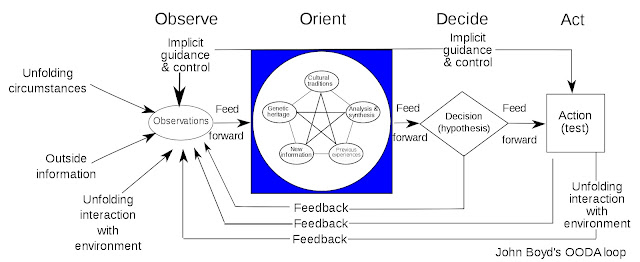
Recursion, feedback loops and the journey to forever resonates when viewing this terrific illustration showing just how wondrous reality truly is. At the same time, while looking at the image, the limits of knowledge comes to the fore as one can never know everything about any given event thanks to Heisenberg's uncertainty principle, Godel's incompleteness theorems and Quantum Mechanics because there is no certitude, ever. 

This sentence is false.

Proof of the limits of knowledge writ large applies because if the sentence is true, how can it be false at the same time?

Uncertainty also applies in classic space as one cannot ascertain the momentum of a cue ball and its position at the same time. You can get very very close but not perfect.

As for certitude, go to a parking lot that's full. You know a space will open but not when.


The limits to knowledge rules ... yet again.


How to negotiate reality ...


Situational awareness applies as does Destruction and Creation.

Saturday, March 29, 2014

Emergence


Alan Turing, one of the true giants in both science and technology, has appeared in BRT in numerous articles describing his work, not only as the inventor of AI and the digital computer (along with John Von Neumann) but also on his seminal contribution to Chaos (Stone Soup) when he posited his then revolutionary theory of how patterns emerge from seeming randomness as seen through the coloration of animals. Now, it seems researchers have put Turing's theory to the test and found out he was right about how chaos functions in the real world.

According to Turing’s theory, designs like fur patterns result from the interactions between individual cells; in other words, the state of a cell influences that of its neighbors, and they, in turn, influence their neighbors. You can see the results of this process in the images collected here; they’re a kind of digital representation of Turing’s idea, except using pixels instead of cells. It’s the relationship among these cells and pixels that ultimately produces a pattern from randomness — a relationship that relies on interacting, molecular signals that spread among groups of otherwise identical cells.

Turing called this the reaction-diffusion process, meaning that it’s driven by reactive molecules that can diffuse between cells. He called these molecules “morphogens” because they affect the morphology, or physical character, of a cell. One molecule activates a change, like color, and one inhibits it. Patterns are produced by varying concentrations of the morphogens as they interact and spread through a population of cells.

The video above shows how this interaction works, something, in this case, psychedelic, wonderful and spot on. :) Seen below is a double pendulum example of chaos in action.


Monday, February 20, 2023

The ability to see ... the future

Ada Lovelace, the first true programmer, was extraordinary to the nth degree.

In her notes, which ended up twice as long as the original article, Lovelace drew on different areas of her education. She began by describing how to code instructions onto cards with punched holes, like those used for the Jacquard weaving loom, a device patented in 1804 that used punch cards to automate weaving patterns in fabric.

Having learned embroidery herself, Lovelace was familiar with the repetitive patterns used for handicrafts. Similarly repetitive steps were needed for mathematical calculations. To avoid duplicating cards for repetitive steps, Lovelace used loops, nested loops and conditional testing in her program instructions.

The notes included instructions on how to calculate Bernoulli numbers, which Lovelace knew from her training to be important in the study of mathematics. Her program showed that the Analytical Engine was capable of performing original calculations that had not yet been performed manually. At the same time, Lovelace noted that the machine could only follow instructions and not “originate anything.”

Ada Lovelace created this chart for the individual program steps to calculate Bernoulli numbers.   Photo: Courtesy of Linda Hall Library of Science, Engineering Technology, CC BY-ND

Finally, Lovelace recognized that the numbers manipulated by the Analytical Engine could be seen as other types of symbols, such as musical notes. An accomplished singer and pianist, Lovelace was familiar with musical notation symbols representing aspects of musical performance such as pitch and duration, and she had manipulated logical symbols in her correspondence with De Morgan. It was not a large step for her to realize that the Analytical Engine could process symbols — not just crunch numbers — and even compose music.

The Analytical Engine


The second programmer ...

In 1936, Turing wrote “On Computable Numbers,” in which he reformulated and advanced ideas first put forward by Kurt Gödel in 1931, positing the existence of what would be called “Turing machines” — an abstract computing device that was intended as an aid to exploring the limitations of what could be computed — and demonstrating that such devices could in principle perform any mathematical computation that was represented as an algorithm.

The Rabbit Hole beckons ...

1. The Imitation Game

I PROPOSE to consider the question, ‘Can machines think?’ This should begin with definitions of the meaning of the terms ‘machine’ and ‘think’. The definitions might be framed so as to reflect so far as possible the normal use of the words, but this attitude is dangerous. If the meaning of the words ‘machine’ and ‘think’ are to be found by examining how they are commonly used it is difficult to escape the conclusion that the meaning and the answer to the question, ‘Can machines think?’ is to be sought in a statistical survey such as a Gallup poll. But this is absurd. Instead of attempting such a definition I shall replace the question by another, which is closely related to it and is expressed in relatively unambiguous words.

The new form of the problem can be described in terms of a game which we call the ‘imitation game’. It is played with three people, a man (A), a woman (B), and an interrogator (C) who may be of either sex. The interrogator stays in a room apart from the other two. The object of the game for the interrogator is to determine which of the other two is the man and which is the woman. He knows them by labels X and Y, and at the end of the game he says either ‘X is A and Y is B’ or ‘X is B and Y is A’. The interrogator is allowed to put questions to A and B thus:

The kicker ...

We now ask the question, ‘What will happen when a machine takes the part of A in this game?’ Will the interrogator decide wrongly as often when the game is played like this as he does when the game is played between a man and a woman? These questions replace our original, ‘Can machines think?’ - Alan Turing


To be continued ...

Sunday, March 12, 2023

AI - A Primer


Out of darkness ...

What’s past is prologue - The Tempest
A journey of a thousand miles begins with a single step. - Lao Tzu

artificial intelligence (abbreviation: AI) noun
the theory and development of computer systems able to perform tasks that normally require human intelligence, such as visual perception, speech recognition, decision-making, and translation between languages.—The New Oxford American Dictionary, Third Edition

The quest for AI begins … 

1834: Ada Lovelace, the first programmer, meets Charles Babbage, inventor of The Analytical Engine, the first digital computer. Upon seeing the first section of the machine, Lovelace not only realizes the system is capable of performing original calculations but also can process other types of symbols like musical notes. Said hardware was never completed in Babbage’s lifetime as the engineer was not paid upfront but it was completed later on and worked as advertised. Lovelace programmed using Jacquard Loom punchcards. 

1945: John Von Neumann invents the modern computer consisting of … 

Note: Turing did the same thing but his design never took off. Von Neumann gave him credit. 

1947: The transistor, a semiconductor, invented by Bardeen, Shockley and Brattain, becomes the processing unit used by every digital system in the world.

Machine language, driven by the transistor, is binary, consisting of 0s & 1s. This ultimate simplicity, turning on & off like a light switch, gives rise to the ultimate complexity as 0s and 1s can be stored, processed and distributed without limitation. Additionally, through abstraction (computer operating system/programming language/software program), said bits can represent colors, sounds, graphics or any other content able to run on top of the aforementioned 0s & 1s, entities processed by every known computer in the world. 

1962: The internet emerges, courtesy the Department of Defense, enabling computers to communicate on a distributed network. TCP/IP (Transmission Control Protocol/Information Protocol).

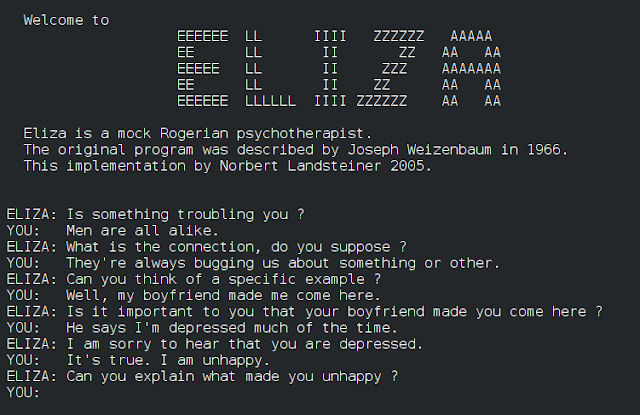
1966: ELIZA, the first chatbot “therapist”, emerges from MIT, the first program to invoke the Turing Test. People thought the clever scripting app was sentient.

1966: The concept of an analog neural net was envisioned but without prerequisite compute power, nothing of note happened.

1966: AI, trying to emulate the functions of the brain by traditional means, goes nowhere.

1965-78: IBM’s System/360, the first general-purpose computer, changes business.

1969: Thompson & Richie create Unix, the first networked-centric OS.

1981: the IBM PC, changes the world.

Truly powerful machines arrive thanks to Moore's law whereby the number of transistors in a dense integrated circuit (IC) doubles about every two years.

1989: The World Wide Web, courtesy CERN and Berner Turner’s Lee, becomes the information appliance able to run on the internet using web browsers to access websites and other entities able to be found using URLs, Uniform Resource Locators. Software becomes web-centric.

1990: the search for web content begins. 

1991: Linux, the open-source variant of Unix, becomes the defacto OS for the Internet. As of 2022, 96.4% of all internet servers run on Linux.

1994: Web Crawler enables one to find any word on any webpage. 

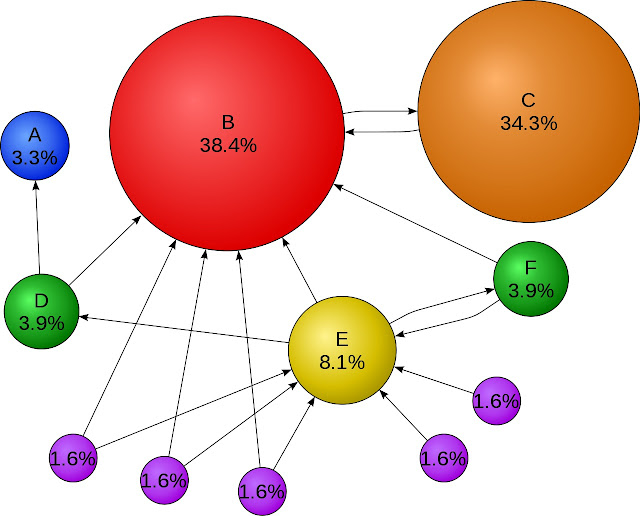
1996: the first search algorithm used to determine page rankings via hyperlinks arrives.


1997: IBM’s Deep Blue beats world chess champion Garry Kasparov in six games.

1998: Google enters the search arena using similar tech with the added benefit of selling search terms.

1998:  Google becomes the search engine king. This iterative algorithm ranks web pages based on the number and PageRank of other websites and pages that link there, on the premise that good or desirable pages are linked to more than others. 

AI goes prime time.

2010: Deep Mind, a pioneering British AI Company, is bought by Alphabet/Google in 2015.

2011: IBM’s Watson beats Jennings and Rutter in Jeopardy.

2016: Deep Mind’s AlphaGo solves Go. 

2020: Deep Mind’s AlphaZero defeats other AIs in Chess, Go and shoji.

2021: Deep Mind’s AlphaFold begins to solve how proteins fold. Said app’s open source.

2022: Deep Mind’s MUZero master games without knowing their rules.

        2022: “Time to Edit,” the time required by the world’s highest-performing professional translators
        to check and correct MT-suggested translations is one second. Current AI = 2 seconds.”

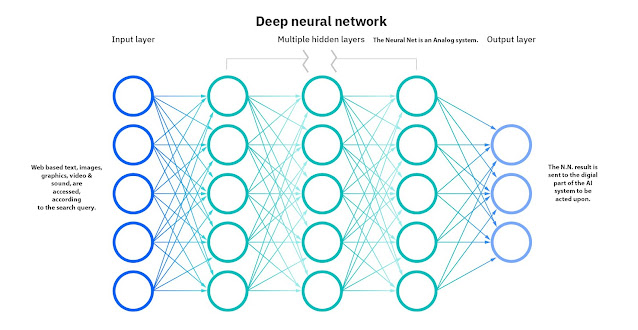
All Deep Mind apps use neural nets, the analog front end, enabling programs to input massive amounts of data needed to train the AI in order for the system to master the discipline in question. 


A neural net -  The input, based on a query and encoded in analog, samples video, images, sound etc., etc.. as needs warrant. Any hits passing a designated threshold is sent (output) to the digital part of the system, ready to be analyzed and acted upon by the entity conducting the search.
Analog measures, digital counts.

The real power of AI centers on analog as it’s ideally suited to deal with the vagaries of reality while digital, a fragile process requiring absolute precision in order to function, has the prerequisite ability to analyze and act upon whatever analog output the neural net generates.

ChatGPT, Dall.e 2, GPT3 & Bard use neural nets in their architecture and employ similar text input to conduct searches but the generated response to the query is specific to the AI variant in question with Open AI’s Chat GPT writing out text, DALL-E 2 creating 3D photorealistic images and GPT3 producing code. Google’s Bard’s equivalent to ChatGPT. Note: Only Google’s Bard is currently connected to the net. Note II, Google’s also developing variants similar to Open AI’s. Addendum: ChatGPT-4 is twice as powerful as 3.

2023: It’s tulip time with AI with Microsoft kicking in 10 billion to Open AI as its technology poses the first serious threat to Google’s core business. Hedge funders jump in on the fun as well.

The Question …

Is AI sentient? At this point in time, no, but does it matter as the implications of the tech in 2023 are already becoming rather profound, ranging from students using ChatGPT to write college essays to scientists using the app to search for scientific information relevant to their areas of expertise but there’s more. In essence, AI’s beginning to impact all disciplines requiring thought.

A Faustian bargain or There Ain’t No Such Thing As A Free Lunch.

The good … Just a tiny list … AI’s beginning to unravel the complexities of cancer. It’s revolutionizing man’s view of the universe and it’s paving the way to making drugs safer and more effective. AI’s beneficial impact on renewables will change how we produce energy on planet earth. This benefit also applies to all things related to medical.

Conversely, by 2025, 90% of all online content will be synthetic so who do you trust? 

2023: Middle Management Blues … “That said, the fact that a full quarter of those respondents said they've already replaced workers with AI — and with 93 percent saying they plan to expand use of AI.

Future layoffs are on the horizon, too. An ominous 63 percent of business leaders believe that integrating ChatGPT will either "definitely" or "probably" lead to culling their human workforce.

So far, 66 percent of the companies employing ChatGPT use it to write code, 58 percent for copywriting and content creation, 57 percent for customer support, and 52 percent for summarizing meetings and documents, the survey found.

The business leaders are easily impressed, too, with 55 percent saying ChatGPT's quality of work is “excellent".

There is no certitude

When going to the store, the parking lot’s full but one knows a parking place will eventually open up, we just don’t know WHEN. :) Probabilities rule. Quantum Mechanics, physics of the very small. Note: Without quantum mechanics, computers would not exist.

Who controls the past controls the future, who controls the present controls the past.—1984. 

Everything is theoretically impossible, until it is done. Robert A. Heinlein

AI’s the first open-ended tech created by man. 

Tech has no morality. It depends on who’s using the tech in question. 

In order for AI to do real-time searches, it requires software writing software able to conduct real-time searches in the real world in real-time, which means … We don’t know how AI works because human programmers cannot write code in real-time to conduct real-time searches using evolving genetic algorithms to improve said search in real-time in any way, shape or fashion. 

What happens if the software decides to do the search in order to evolve? 

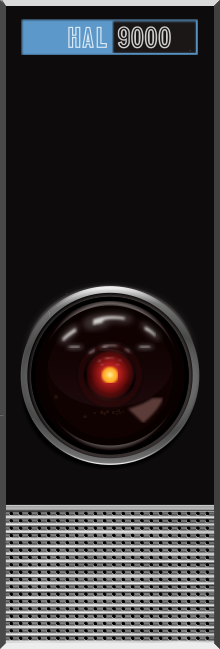
1968: HAL 9000/2001


2015: “Out of control AI will not kill us believes Microsoft Research chief. Prof Stephen Hawking tells the BBC that such machines could ‘spell the end of the human race’”.

2015: “Looking ahead, many researchers are pursuing 'AGI', general AI which can perform as well as or better than humans at a wide range of cognitive tasks. Once AI systems can themselves design smarter systems, we may hit an 'intelligence explosion', very quickly leaving humanity behind. This could eradicate poverty or war; it could also eradicate us.

That risk comes not from AI's potential malevolence or consciousness, but from its competence - in other words, not from how it feels, but what it does. Humans could, for instance, lose control of a high-performing system programmed to do something destructive, with devastating impact. And even if an AI is programmed to do something beneficial, it could still develop a destructive method to achieve that goal.

AI doesn't need consciousness to pursue its goals, any more than heat-seeking missiles do. Equally, the danger is not from robots, per se, but from intelligence itself, which requires nothing more than an internet connection to do us incalculable harm.” 

2017: The Dark Secret at the Heart of AI “No one really knows how the most advanced algorithms do what they do. That could be a problem.”

When resources get scarce, bots become all too human.

2017: “When apples were abundant, the two agents were happy to collect their fruit without targeting each other. But in more scarce scenarios with fewer apples around, the agents became more aggressive. The researchers also found that the greater the “cognitive capacity” of the agent, the more frequently they attacked their opponent. This makes sense, as in this scenario attacking an opponent is more complex behavior and so requires greater intelligence.”

2019: The rise of the machines … “US Navy moves toward unleashing killer robot ships on the world’s oceans.

2021: “Superintelligence cannot be contained:

‘Machines take me by surprise with great frequency.  This is largely because I do not do sufficient calculation to decide what to expect them to do.’” Alan Turing (1950)  Journal of Artificial Intelligence Research

2022: “Last March, a group of researchers made headlines by revealing that they had developed an artificial-intelligence (AI) tool that could invent potential new chemical weapons. What’s more, it could do so at an incredible speed: It took only 6 hours for the AI tool to suggest 40,000 of them. The most worrying part of the story, however, was how easy it was to develop that AI tool.” 

The implications of AI are too important to ignore. People tend to think of AI as a static thing, not as an actual set of millions of interconnected things, an ever-evolving entity living in a distributed environment where duplication, modification and updating of real-time code work at speeds far beyond the kin of man. With this in mind, an excellent article by Henry Kissenger titled How the Enlightenment Ends, connects AI to the Enlightenment at deep level, a piece needing to be read by everyone concerned about how AI will impact society as we move further into the 21st century.

Tech never sleeps.

“Question everything.” - Einstein

Robert E. Moran - CEO, Digital Constructs Inc. 

This is a web-centric version of a piece written by yours truly for a local pub. :)