Showing posts sorted by relevance for query limits of knowledge. Sort by date Show all posts

Friday, March 12, 2021

The limits of knowledge


We will never know everything but you already know that, right? Georg Cantor proved this to be so with infinities within infinites using his Canter Sets to make it happen. The Menger Sponge, seen above, is a 3D representation of the set seen below. 


Cantor's set pointing to infinities residing in infinities within finite space shows, indirectly, the inherent limits of knowledge.

Why this exercise in contemplating this fascinating issue? Well, the limits of knowledge remains forever universal simply because we cannot ascertain the complete totality of a given event let alone properly describing the initial condition of said event in question as stated by chaos theory. 


For deterministic systems, even if one could not know exactly what would happen in practice (because of inexact or otherwise incomplete knowledge of earlier states), well-formed probabilistic estimates of the most likely outcomes might still be possible. Thus, even if we cannot know whether a particular flipped coin will end up heads or tails, we know that its end state will surely be either heads or tails and even what the likely distribution of heads and tails will be over any repeated set of tosses.

Implicit in that probabilistic analysis, however, is an assumption that all the possible outcomes can be stated in advance. Without foreknowledge of this sample space, one lacks the basis for compiling the appropriate statistics. Systems for which the sample space cannot be prestated seem to preclude the formation of meaningful probability statements.

As described in the main text, we believe that economic systems fall into this category. One cannot anticipate all possible future innovations by simply listing all possible combinations of prior ones: it is impossible to know what features of those earlier goods might be useful in the future because new goods and services can invent completely novel uses of old ones (and sometimes eliminate old ones).

Full knowledge of the movements of a  two body system works but not for three.

In physics and classical mechanics, the three-body problem is the problem of taking the initial positions and velocities (or momenta) of three point masses and solving for their subsequent motion according to Newton's laws of motion and Newton's law of universal gravitation.[1] The three-body problem is a special case of the n-body problem. Unlike two-body problems, no general closed-form solution exists,[1] as the resulting dynamical system is chaotic for most initial conditions, and numerical methods are generally required.

End result, the limits of knowledge remains forever absolute so ... as per the Tao, assume nothing. :)

Thursday, August 17, 2023

The limits of knowledge/rev X


Recursion, feedback loops and the journey to forever resonates when viewing this terrific illustration showing just how wondrous reality truly is. At the same time, while looking at the image, the limits of knowledge comes to the fore as one can never know everything about any given event thanks to Heisenberg's uncertainty principle, Godel's incompleteness theorems and Quantum Mechanics because there is no certitude, ever. 

This sentence is false.

Proof of the limits of knowledge writ large applies because if the sentence is true, how can it be false at the same time?

Uncertainty also applies in classic space as one cannot ascertain the momentum of a cue ball and its position at the same time. You can get very very close but not perfect.

As for certitude, go to a parking lot that's full. You know a space will open but not when.


The limits to knowledge rules ... yet again.


How to negotiate reality ...


Situational awareness applies as does Destruction and Creation.

Saturday, November 16, 2024

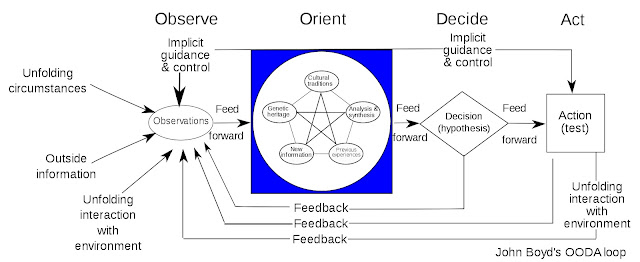
Observe, Orient, Decide, Act,

Observe, Orient, Decide, Act, a set of actions defined by John Boyd's OODA loop. shows, in depth, the steps every organism takes in order to survive also applies to better understanding how the limits of knowledge, driven by uncertainty, incompleteness and entropy, depict a reality we will never fully understand.  To see why, the animation depicting one example of chaos beckons. :) 


Interesting enough, OODA, when examined closely, relates to the act of creation without question.

  1. The Act of Creation - Arthur Koestler: The creative act is the joining together of two or more seemingly dissimilar ideas that generate a heretofore unexpected result. i.e. Chemistry - H20 consists of 2 Hydrogen + 1 Oxygen atoms, both explosive yet, when combined, becomes water. 
  2. The joke: Henny Youngman - Take my wife, Please. :)
  3. Creativity starts with curiosity, the start point to the asking of a question:
    Why is this the way it is?
  4. Question everything - Einstein
  5. Creation & destruction is part of the creative process as everything has a cost thanks to the two laws of thermodynamics.
  6. The ability to see relationships is key as everything is connected because reality is a Quantum space and entanglement stitches it together.
  7. The creative act is always visual. Think Stevie Wonder and Songs in the Keys of life.
  8. Play is indispensable. What if ... is the real deal here. A sense of wonderment is key.
  9. Creativity takes courage as new ideas disrupt the "natural" order of things.
  10. Creativity is problem-solving. It matters not the discipline used save that said discipline shapes how the creative act is produced.
  11. The act itself is ineffable and cannot be explained. Like quantum, creativity just happens. It cannot be forced, only acted upon when the idea shows up. The finished act can be explained after the fact without question.
  12. Practice makes better. Beginners mind and intuition rule.
  13. Attention to details.
  14. Passion is a prerequisite to create anything of value.
  15. The creative act is selfish. One does not create for others, only for oneself.
  16. The size of the problem solved dictates the significance of the creative act. i.e. Mixing anchovies with pineapples on a pizza is a creative act. The size or importance of the problem solved, not so much while Einstein's Theory of relativity proving that Newton was wrong at universal scale, is.
  17. Creativity, like tech and existence, has no morality. It simply is.
  18. Stay hungry, stay foolish - Stewart Brand/Whole Earth Catalog. :)
  19. AI is but a tool, the issue now becomes, does the tool become the master? A good question to ask is it not?
  20. Being first to come up with a new idea is essential. Darwin & Wallace relates as Wallace was two weeks later than Darwin in explaining why evolution matters.
  21. The Act of Creation, whenever possible, runs counter to the limits of knowledge as needs warrant.

Circularity

 Characteristics of great art
  1. Clarity.
  2. Simplicity. It's easy to be complex, simplicity is hard. Einstein: Keep it simple, not simpler.
  3. Good artists create, great artists steal. - Picasso
  4. Great art always involves the process of discovery.
  5. Timeless. Bach, like fine wine, never ages.
  6. No spin. 
  7. Details, details, details.
  8. As stated before, great art applies to all disciplines.
  9. Connections to differing disciplines apply.
  10. Less is more. Dizzy Gillespie
  11. Great artists are never afraid to make mistakes.
  12. Doggedness. It takes thousands of hours to become good at something. 


Kind of Blue is considered to be the greatest jazz album of all time even though
Oliver Nelson's The Blues and the Abstract Truth is right up there on the pantheon of the greatest of all time IMHO. This is not about KOB per se but rather about Bill Evans' liner notes and why his writing is just as profound as the album itself because it's all about improv and it's role in the creative process.

To whit.


A notion of Einstein's Special Relativity ... Vue style :)

Remember, walking is controlled falling. 

Sunday, December 15, 2024

There is no off ramp :)


Mirror Beach


S = entropy
k_{b} = Boltzmann constant
\ln = natural logarithm
\Omega = number of microscopic configurations

Being rather limited in math to say the least, this "simple" equation explains in a way even I can understand as entropy is the driving engine of the 2nd law of thermodynamics. When paired with the first, the two define reality as being an environment sustained by the ever moving essence of energy.


But it's more than that ...


Heisenberg's Uncertainty Principle & Entropy, a match make in heaven


We will never know everything but you already know that, right? Georg Cantor proved this to be so with infinities residing within infinities using his theory of transfinite numbers to make it happen. The Menger Sponge, seen above, is a 3D representation of Cantor's theory.

In closing ...


Low


High

In closing ...


Everything's connected and entangled, this is why we rubes have a consistent view of a "uncertain" reality we will never fully understand. Awesome to a fault without question if you're one willing to question. :)

And so it goes ... K. Vonnegut

Monday, July 26, 2021

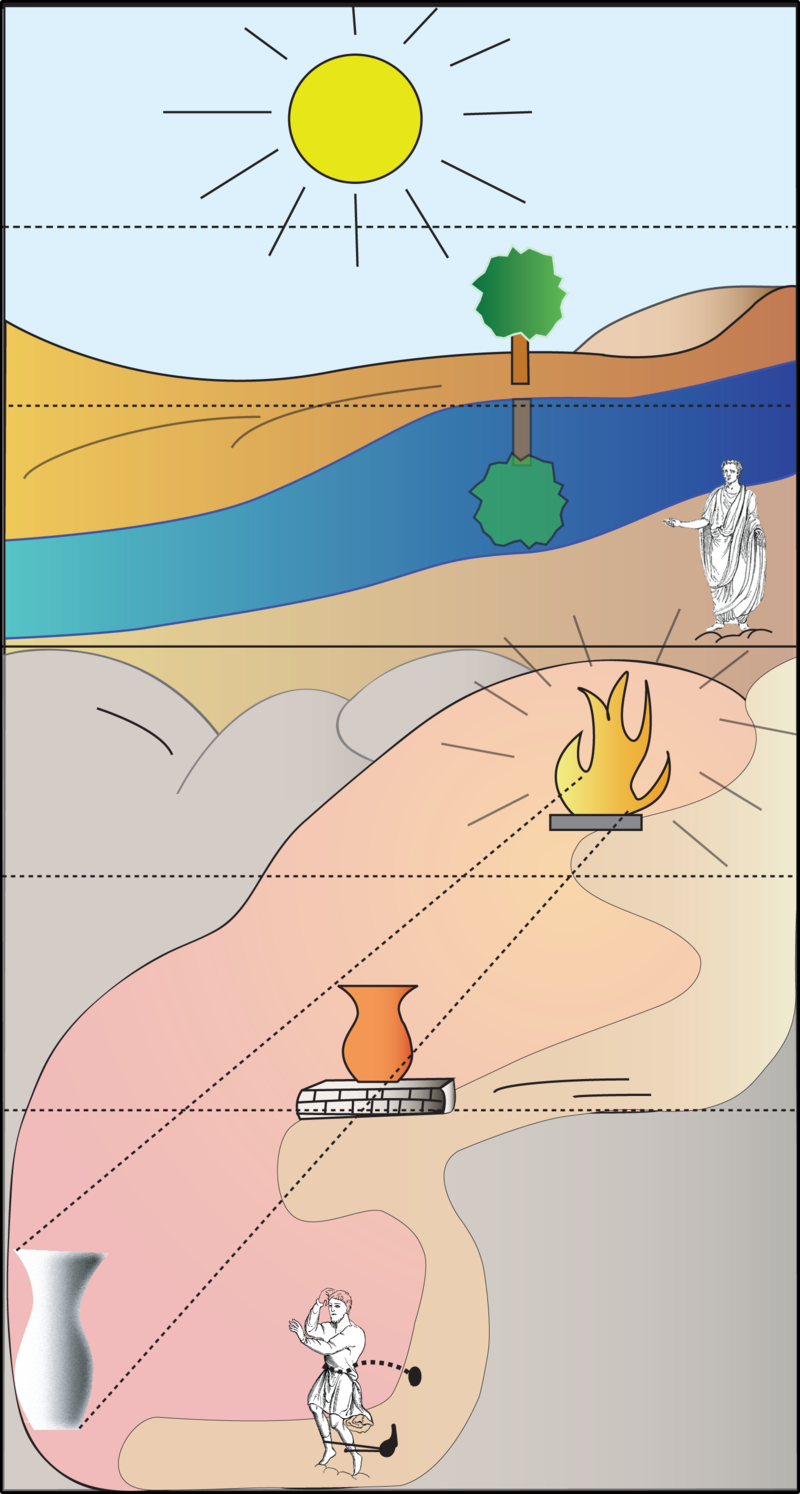
Plato's cave


BRT has written copiously about The Limits of Knowledge as quantum reality works in ways beyond the kin of man. From Plato to Einstein, the quest to learn how existence works never ends as nature's the ultimate trickster, forever keeping the true essence of herself forever hidden from our prying eyes.

More than a half century ago, Richard Feynman advised us to accept that nature makes no sense. “Do not keep saying to yourself … ‘But how can [nature] be like that?’” Feynman warns in The Character of Physical Law, “because you will get ‘down the drain,’ into a blind alley from which nobody has yet escaped. Nobody knows how it can be like that.” Most physicists have followed Feynman’s advice. Ignoring the oddness of quantum mechanics, they simply apply it to accomplish various tasks, such as predicting new particles or building more powerful computers.

Today, there are more interpretations than ever, but they deepen rather than dispel the mystery at the heart of things. The more I dwell on puzzles such as superposition, entanglement and the measurement problem, the more I identify with the piranha. I’m blindly thrashing about for insights, epiphanies, revelations. Every now and then I think I’ve grasped some slippery truth, but my satisfaction is always fleeting. Sooner or later, I end up crashing into an invisible barrier. I don’t really know where I am or what’s going on. I’m in the dark.

Plato's Cave, ...

In the allegory, Socrates describes a group of people who have lived chained to the wall of a cave all their lives, facing a blank wall. The people watch shadows projected on the wall from objects passing in front of a fire behind them and give names to these shadows. The shadows are the prisoners' reality, but are not accurate representations of the real world. Three higher levels exist: the natural sciences; mathematics, geometry, and deductive logic; and the theory of forms.

Socrates explains how the philosopher is like a prisoner who is freed from the cave and comes to understand that the shadows on the wall are actually not reality at all. A philosopher aims to understand and perceive the higher levels of reality. However, the other inmates of the cave do not even desire to leave their prison, for they know no better life.[1]

Allegory of the cave. From top to bottom: The sun ("good" ideas) Natural things (ideas) Reflections of natural things (mathematical objects) Fire (light) Artificial objects (creatures and objects) Shadows of artificial objects, allegory (image, analogy of the sun and of the divided line)

The limits of knowledge indeed ...


Thursday, July 06, 2023

The Limits to Growth ...

Illustration by Maria Contreras

Prior to the rise of oil, the standard of living for the great majority of people on planet earth was marginal at best. As per Thomas Hobbes ... In such condition there is no place for industry, because the fruit thereof is uncertain: and consequently no culture of the earth; no navigation, nor use of the commodities that may be imported by sea; no commodious building; no instruments of moving and removing such things as require much force; no knowledge of the face of the earth; no account of time; no arts; no letters; no society; and which is worst of all, continual fear, and danger of violent death; and the life of man, solitary, poor, nasty, brutish, and short’ 


With advent of oil comes abundance ...

John Maynard Keynes once observed that dating from “say, to two thousand years before Christ—down to the beginning of the 18th century, there was no very great change in the standard of life of the average man living in the civilised centres of the earth. Ups and downs certainly. Visitations of plague, famine, and war. Golden intervals. But no progressive, violent change.” At best, he calculated, the average standard of living had no more than doubled in the previous four millennia, essentially because, when that epoch began, we already knew about fire, banking, the sail, the plow, mathematics; we learned little new that would have accelerated economic growth; and throughout that stretch the planet mostly ran on the muscles of people and animals, supplemented by the power of wind and water. Then, in the eighteenth and nineteenth century, we started to harness the combustion of coal, gas, and oil, and everything changed. That’s because a barrel of oil contains 5.8 million British thermal units’ worth of energy. Nate Hagens, the director of the Institute for the Study of Energy & Our Future, ran the numbers: “One barrel of oil has the same amount of energy of up to 25,000 hours of hard human labor, which is 12.5 years of work. At $20 per hour, this is $500,000 of labor per barrel.” A barrel of oil costs about seventy dollars at this week’s market price.

To call that energy revolution liberating hardly suffices. Suddenly, people could easily venture beyond their villages, or build dwellings large enough to afford some privacy, or stay up all night if they wanted to read. After four thousand years of economic stasis, we were suddenly in a world where the average standard of living doubled in a matter of decades, and then doubled again and again and again and again. And we liked it so much that it became the raison d’être of our political life. In the United States, the per-capita G.N.P. grew twenty-four per cent between 1947 and 1960, when Jack Kennedy, campaigning for President, pointed out that Russia’s growth rate was “three times as fast,” a gap he tried to narrow while in office. Between 1961 and 1965, the G.N.P. grew at a rate greater than five per cent a year, and the percentage of Americans living in poverty dropped by nearly half by the end of the decade. If there was anything Americans agreed on, it was that they wanted more, please. In the 1996 campaign, for instance, the Republican Vice-Presidential nominee, Jack Kemp, demanded that we double the rate of growth, while Bill Clinton’s Secretary of the Treasury, Larry Summers, said that we “cannot and will not accept any ‘speed limit’ on American economic growth. It is the task of economic policy to grow the economy.”

and cost ...

But a critique of growth was emerging in the postwar years as well, most concisely in a 1972 report commissioned by the Club of Rome titled “The Limits to Growth.” A team of M.I.T. economists used computer models (then something of a novelty) to show that, if we kept growing at the then-current rate, the planet could expect ecological collapse sometime toward the middle of the twenty-first century. That prediction turns out to have been spot-on: a report published in Nature on the last day of May concluded that we have already exceeded seven of eight “safe and just Earth system boundaries” that it studied—from groundwater supplies and fertilizer overuse to temperature. “We are moving in the wrong direction on basically all of these,” Johan Rockström, the paper’s lead author and the director of the Potsdam Institute for Climate Impact Research, told reporters. 

Click here to get Limits to Growth in PDF.

Monday, March 06, 2023

Somewhat right ... Dall'e 2 experiments ... :)


The double slit experiment/rev 1


Plato's cave/rev XX


The single slit ...


When measurement occurs


Superposition/rev X


Strange Attractors/Chaos/rev XXX


The limits of knowledge


Channeling Francis Bacon


Channeling Francis Bacon/Rev II

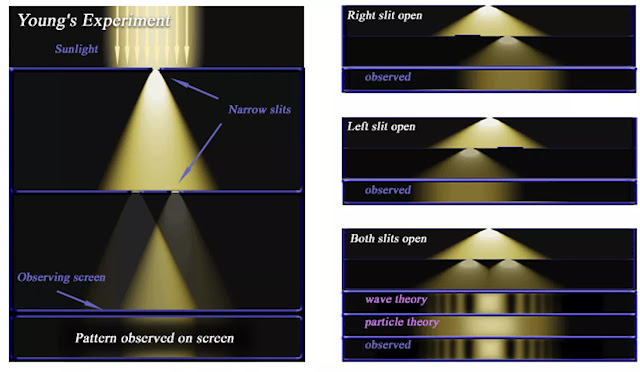
Dall'e-2 has growing pains, particularly when trying to accurately describe quantum physics in the guise of the 1805 Thomas Young Double Slit Experiment. Plato's cave is my favorite as an incorrect but fanciful expression of the most beautiful experiment in science as it resonates, in indirect fashion, to Plato's attempt to describe the true essence of existence. The fourth picture shows the act of "measuring" a given subatomic particle as said entity exists both as a wave and a particle at the same time until measured, an act that not only collapses the entity in question into a particle but also shows where the most likely location of the particle might be. :) 

The 5th shows superposition when a sub-atomic entity is not measured. 

The 6th reflects chaos theory and its notion of a strange attractor. 

The 7th depicts the limits of knowledge as man will never know the full extent of reality.

The last two pix were intended as "A watercolor painting in the style of Andrew Wyeth of an annoyed snow leopard in a spaceship" but Dall'e 2 decided a Francis Bacon take would be better. :)

As reference, here's an accurate pix of Young's wonderful experiment.


The single slit image by yours truly's spot on IMHO. :)

Thursday, June 24, 2021

Limits of knowledge rev XX


Blue indigo


Night for Day


Open window


Stone wall


Solitude


 Emergence

All these pix show aspects of the great invisible whether it be Night for Day or the infrared driven images of Solitude and Blue Indigo as our eyes cannot see reality in a light spectrum outside of the tiny subset of what we see without the aid of tech. 

As for the stone wall, this image indirectly shows the passage of time with the oldest at the bottom and the latest at the top. As for Open Window & Emergence, darkness invokes mystery even in the bright of day.

To yours truly, the limits of knowledge resides everywhere, even in the commonplace as depicted in the pictures seen above. :)