Tuesday, July 04, 2023

The First Law of Holes


A quote most apt when it comes to the far right and the sheer incompetence people like Trump, Bolsonaro and Boris Johnson exhibit regarding all things related to governance. This incompetency extends to others, particularly when adhering to the Peter Principle, an observation that the tendency in most organizational hierarchies, such as that of a corporation, is for every employee to rise in the hierarchy through promotion until they reach a level of respective incompetence.


Think Musk and Twitter as Example No. 1


Example No. 2


Blowback, the law of unforeseen consequences, looms.

blow·back
/ˈblōbak/
noun
  1. 1. 
    a process in which gases expand or travel in a direction opposite to the usual one, especially through escape of pressure or delayed combustion.
  1. the unintended adverse results of a political action or situation.
    "this is the blowback from all those aggressive public health campaigns"

Any questions?

Funhouse

A robot using a computer

TPhoto: JoeBakal / Shutterstock.com (Shutterstock)

When reading this blurb, think The Man Who Came to Dinner, a biting comedy about a family being terrorized by Sheridan Whiteside, a self-absorbed boor of a man who slips on a patch of ice prior to an arranged dinner with Ernest W. Stanley and his family. 

Confined to the house for a month, Whiteside drives his hosts mad by viciously insulting them, monopolizing their house and staff, running up large phone bills, and receiving many bizarre guests, including paroled convicts, and the eccentric Professor Metz, who brings him a glass-encased cockroach colony. Although he earns the intense dislike of Mr. Stanley, Whiteside manages to befriend his adult children, June and Richard, as well as his wildly eccentric older sister, Harriet Stanley. 


Written by George S. Kaufman and Moss Hart, it's funny as hell but this blurb's not about the play but rather about Google explicitly saying the company reserves the right to scrape just about everything you post online to build its AI tools. If Google can read your words, assume they belong to the company now, and expect that they’re nesting somewhere in the bowels of a chatbot. 

Something akin to a digital Sheridan Whiteside who will never go away comes to mind here, right?

To whit ...

The practice raises new and interesting privacy questions. People generally understand that public posts are public. But today, you need a new mental model of what it means to write something online. It’s no longer a question of who can see the information, but how it could be used. There’s a good chance that Bard and ChatGPT ingested your long forgotten blog posts or 15-year-old restaurant reviews. As you read this, the chatbots could be regurgitating some humonculoid version of your words in ways that are impossible to predict and difficult to understand.

One of the less obvious complications of the post ChatGPT world is the question of where data-hungry chatbots sourced their information. Companies including Google and OpenAI scraped vast portions of the internet to fuel their robot habits. It’s not at all clear that this is legal, and the next few years will see the courts wrestle with copyright questions that would have seemed like science fiction a few years ago. In the meantime, the phenomenon already affects consumers in some unexpected ways.

It goes beyond that as our posts, in effect, are no longer ours, content able to be distorted and manipulated by entities like Google as needs warrant. Think Funhouse, I know I have. 


Funhouse ... complete with feet 2020

 At the end of the play, Whiteside slips on the ice yet again while leaving the Stanley's. 

Monday, July 03, 2023

The principle of least action ...


Mirror, Mirror

The principle of least action defines just how lazy reality truly is when viewed through the lens of the two laws of thermodynamics where energy is neither created nor destroyed, only transformed and ... in any closed system, said system always goes to the state of maximum disorder (entropy) because the arrow of time rules. 

The Principle of Least Action says that, in some sense, the true motion is the optimum out of all possible motions, The idea that the workings of nature are somehow optimal, suggests that nature is working in an efficient way, with minimal effort, to some kind of plan. But nature doesn’t have a brain that is “trying” to optimize its performance. There isn’t a plan. It just works out that way.


Lest we forget. :)


And, of course, Dizzy.

Less is more. 

Addendum:

 BRT waxes poetic about design and nature with The 2nd Law. 

Chaos and the Law of Initial Conditions also apply to the Principle of least action without question. 

The Tides ...


As stated in the Science Museum Group's article, predicting the tides is rather crucial as civilization needs to know the extent of the rise and fall of the twice-daily movement of tides in order to successfully cope with this crucial aspect of the ocean, a process, prior to Lord Kelvin's invention of the modern analog computer in 1876, given to ad-hoc guesstimates for as long as humans have resided on planet earth. With the advent of digital, analog systems, like Kelvin's, withered away but no longer as AI needs to handle the vagaries of the real world in real-time using neural nets, the analog construct AI must have in order to function. Digital can do the job but only at enormous cost in terms of efficiency and power, something becoming increasingly problematic as society moves further into the 21st century.


Arising from the dead.

Why digital has problems ...

GOING BACK TO the concept of dropping a ball, and my interest in finding out how far it travels during a period of time: Calculus solves that problem easily, with a differential equation—if you ignore air resistance. The proper term for this is “integrating velocity with respect to time.”

But what if you don’t ignore air resistance? The faster the ball falls, the more air resistance it encounters. But gravity remains constant, so the ball’s speed doesn’t increase at a steady rate but tails off until it reaches terminal velocity. You can express this in a differential equation too, but it adds another layer of complexity. I won’t get into the mathematical notation (I prefer to avoid the pain of it, to use Sara Achour’s memorable term), because the take-home message is all that matters. Every time you introduce another factor, the scenario gets more complicated. If there’s a crosswind, or the ball collides with other balls, or it falls down a hole to the center of the Earth, where gravity is zero—the situation can get discouragingly complicated.

MNow suppose you want to simulate the scenario using a digital computer. It’ll need a lot of data points to generate a smooth curve, and it’ll have to continually recalculate all the values for each point. Those calculations will add up, especially if multiple objects become involved. If you have billions of objects—as in a nuclear chain reaction, or synapse states in an AI engine—you’ll need a digital processor containing maybe 100 billion transistors to crunch the data at billions of cycles per second. And in each cycle, the switching operation of each transistor will generate heat. Waste heat becomes a serious issue.

Using a new-age analog chip, you just express all the factors in a differential equation and type it into Achour’s compiler, which converts the equation into machine language that the chip understands. The brute force of binary code is minimized, and so is the power consumption and the heat. The HCDC is like an efficient little helper residing secretly amid the modern hardware, and it’s chip-sized, unlike the room-sized behemoths of yesteryear.


To see why Analog's elegant and cool, click the Veritasium video below 


Remember, analog measures, digital counts. :)

Sunday, July 02, 2023

Beyond computation ...

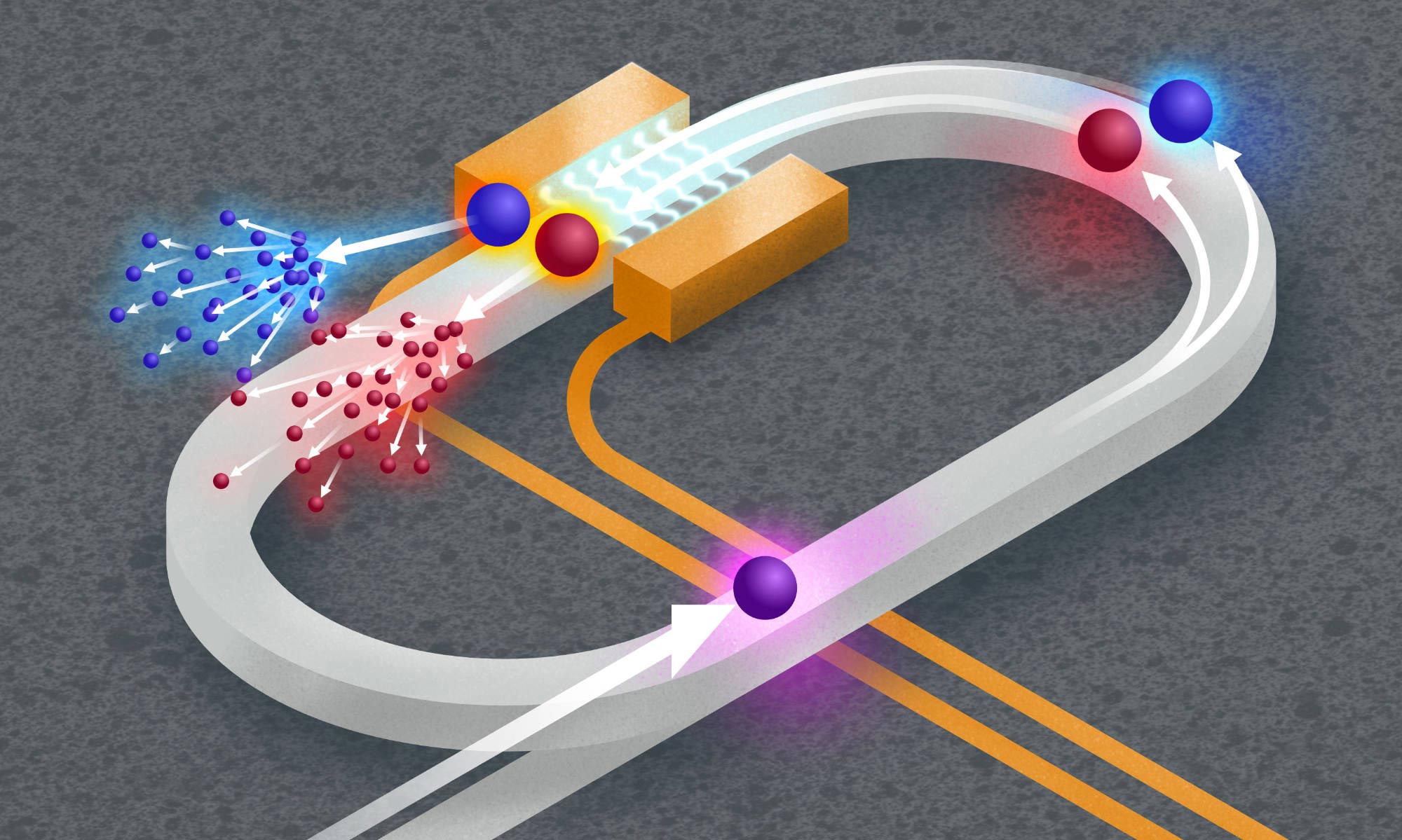
 Synthetic Space Quantum Simulator Model

A new system developed by researchers at the University of Rochester allows them to conduct quantum simulations in a synthetic space that mimics the physical world by controlling the frequency, or color, of quantum entangled photons as time elapses.
Credit: University of Rochester illustration / Michael Osadciw

Everybody talks about quantum computing from the code-breaking and factoring side of things due to the fact the compute power of said systems goes beyond computation because qubits can be 0s AND 1s at the same time, thus exponentially increasing the ability to solve difficult problems beyond the kin of serial processing via bits - 0s OR 1s, the way every non-QC system in the world crunches data. With this said, the real power of QC may be its ability to recreate reality in finite space, a concept discussed in detail by Seth Lloyd in his seminal book titled Programming the Universe.


Recreating reality was just a conjecture, until now.

Saturday, July 01, 2023

CO2 writ frothy ... Blurb 4400


An evil version of a chocolate/coffee ice cream sundae comes to mind here.


I'll think I'll pass on this bad boy if you don't mind.

Atlas 14


Being a designer, yours truly knows a little bit about form following function as all good design projects adhere to this principle without issue. (Think Roman Concrete for example) When things go out of sync, problems arise, something happening in all things related to civil engineering due to climate change and the fact NOAA's Atlas 14 is woefully out of date.

To whit.

NOAA’s precipitation estimates cover almost any U.S. location, and they are crucial to engineers and planners in designing projects such as roads and bridges to withstand the worst downpours.

And that’s why a new report by a leading climate research group calls the North Adams, Mass., station “the most extreme case” of what’s wrong with NOAA’s precipitation data and its disregard for climate change.

The North Adams estimates are based on precipitation records that go back to 1816, which the new report says makes them obsolete and inaccurate because they incorporate 200-year-old data and do not account for the current and future effects of climate change.

The station is unique only in the long time span it covers. At thousands of other weather stations across the United States, NOAA is incorporating decades-old records into current estimates while excluding the effects of climate change. The forecasts are known as the Precipitation-Frequency Atlas of the United States, commonly called Atlas 14.

A report published Monday morning by the nonprofit First Street Foundation warns that new infrastructure projects built today using Atlas 14 data “are instantly decades out of date.”

As a result, the projects are “unable to adequately protect against current and future flood risks from heavy precipitation events,” the report says.

Out of sync indeed.

It's only the beginning ...

 An American flag coiled around a flag pole, within view of the Supreme Court building.

Christopher Lee for The New York Times

It's only the beginning is apt as the SC, the worst in history, continues to deconstruct the Constitution as we speak whether it be separation of church and state or institutionalized discrimination as it matters not to the six zealots residing on the court in the year of our lord 2023. In my lifetime, never have I seen an institution such as this become endemically corrupt, ideologically driven to the extreme or self-aggrandizing to the max in acting as the final arbitrators of law driven by religious ideology in a once great nation known as America.

Let’s be honest about the painful reality: America has functioned as a full democracy — guaranteeing the franchise to all — for less than one human lifetime. In practice, our democracy is younger than me.

I was born in 1959, into an America rived by apartheid. When I was a child, the adults in my life were technically eligible to vote. However, in the Louisiana and Texas towns where I grew up, they were prevented from doing so by the social and cultural norms of the American South.

During the first two decades of my life, the American people finally acknowledged this truth and, to borrow a phrase, acted affirmatively to address it. A new generation of American founders mobilized into a great, multiracial movement, challenged our nation to live up to its ideals and initiated a national construction project on the foundation of the Constitution’s 14th Amendment (which was violated with impunity for an entire century after the nation ratified it).

Diversity is key ...

The data suggests exactly the opposite. Study after study demonstrates that, across organizations, diversity enhances critical thinking, creativity and collaboration, as well as productivity, profitability and performance. It is a national tragedy that diversity is now a contested issue rather than a common interest.

It gets "better".

A protester stands in front of the Supreme Court holding a sign that says “2nd Class Citizen.”

Damon Winter/The New York Times

From Dobbs to Hobby Lobby to Greece NY and 303 Creative v. Elentis, the worst SC in our lifetime, is opening up the floodgates designed to create an emergent theocracy where religion rules while critical thinking, education and the practice of science become increasingly marginalized by a virulent minority intent on dismantling our democracy one ruling at a time.

The Supreme Court has sided with a Christian graphic designer who refuses to create wedding websites for gay or lesbian couples. The result comes as little surprise. Writing for a six-justice conservative majority, Neil Gorsuch said that Colorado’s anti-discrimination law violates the designer’s right to free speech because the state “seeks to force an individual to speak in ways that align with its views but defy her conscience about a matter of major significance.”

The decision in 303 Creative v. Elenis is the latest in a long-running battle between religious business owners and states seeking to protect the L.G.B.T.Q. community. In 2018, the court faced a similar question when a Colorado baker violated the same anti-discrimination law by refusing to bake a wedding cake for a gay couple. The court ruled in favor of the baker on narrow grounds, ducking the broader free speech question.

Now it has addressed that question in a ruling that is deeply significant. More than 20 states, including New York and California, have anti-discrimination laws like Colorado’s. By creating a free speech carve-out from these laws, the court’s ruling threatens to obliterate a vital tool in efforts to protect the L.G.B.T.Q. community at a time when it faces hatred and violence.

Civil war looms ...

Wet Bulb ... 2035


It will take a catastrophe before the world gets serious about GW, guesstimate for said catastrophe,
wet bulb in India around 2035.


The clock is ticking.

Saturn yet again


Saturn never disappoints. :)