Saturday, July 04, 2015

The 1% "Solution"


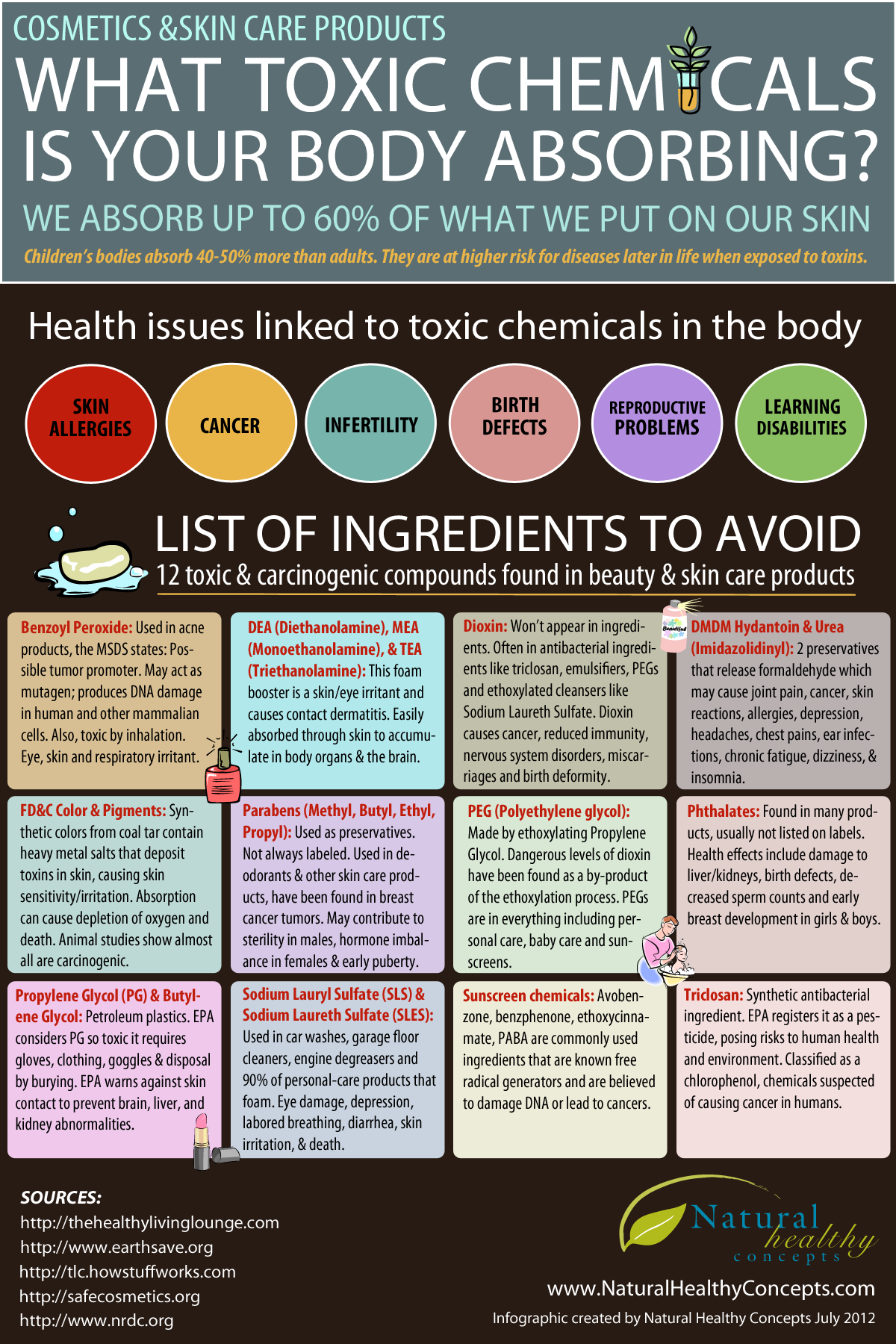
Many people don't think twice about the chemicals they put on their bodies, perhaps thinking that the government regulates the personal care products that flood the marketplace. In reality, the government plays a very small role, in part because it doesn't have the legal mandate to protect the public from harmful substances that chemical companies and manufacturers sell in their products. Federal rules designed to ensure product safety haven’t been updated in more than 75 years. New untested chemicals appear on store shelves all the time.

"Under federal law, cosmetics companies don't have to disclose chemicals or gain approval for the 2,000 products that go on the market every year," notes environment writer Jane Kay in Scientific American. "And removing a cosmetic from sale takes a battle in federal court."

It's high time these rules are revisited. Not only have thousands of new chemicals entered the market in the past several decades, there is overwhelming evidence that the public is unnecessarily exposed to health hazards from consumer products. In 2013, the American College of Obstetricians and Gynecologists issued a report that found "robust" evidence linking "toxic environmental agents" — which includes consumer products — to "adverse reproductive and developmental health outcomes."

Formaldehyde is a good example. It is a known carcinogen used as a preservative to kill or inhibit the growth of microorganisms in a wide range of personal care products, from cosmetics, soaps, shampoos and lotions to deodorants, nail polishes and hair gels. It is also used in pressed-wood products, permanent-press fabrics, paper product coatings and insulation, and as a fungicide, germicide, disinfectant and preservative. The general public is also exposed to formaldehyde through automobile tailpipe emissions. Formaldehyde has been linked to spontaneous abortion and low birth weight.

Something to think about, don't you think?

Making a difference


There are two popes I admire, Pope John the 23rd and Pope Francis, two people who get in terms of how religion should really work in caring for people and the planet and not pontificate, two concepts atheists like myself share as we move further into the 21st century. Pope Francis' Encyclical Letter is truly revolutionary, calling for man to change his ways before it's too late, something BRT has talk about all too often as we move further into the Anthropocene.

Nothing in this world is indifferent to us

3. More than fifty years ago, with the world teetering on the brink of nuclear crisis, Pope Saint John XXIII wrote an Encyclical which not only rejected war but offered a proposal for peace. He addressed his message Pacem in Terris to the entire “Catholic world” and indeed “to all men and women of good will”. Now, faced as we are with global environmental deterioration, I wish to address every person living on this planet. In my Apostolic Exhortation Evangelii Gaudium, I wrote to all the members of the Church with the aim of encouraging ongoing missionary renewal. In this Encyclical, I would like to enter into dialogue with all people about our common home.

Any questions?


Pope John  the 23rd


New Horizon's a Go :)


New Horizons' 3 billion mile trip to Pluto has enchanted the world. No pontification here as yours truly is a big time fan of this exquisite venture of NASA. Can't wait to see what Pluto's all about. Enjoy.

Click on the graphic to get a PDF of the tech behind NH. Stellar to say the least.


Thursday, July 02, 2015

Ignore @ Your Own Peril


Back in 2010, BRT did a piece titled No Doubt Anymore, a blurb about the wonderful Nautilus and the perils this ancient and beautiful creature faces due to increased CO2 injection into the sea, thus increasing ocean acidification, the main culprit in the 5, going on 6, great dyings of planet earth.


It gets "better".


People and countries are starting to wake up but is it enough, can civilization change its ways in time to avoid environmental collapse or does humanity become The Walking Dead within the next 100 years. Only time will tell.


It Ain't Enough


Big data is all about finding patterns in skeins of information using AI, neural nets, genetic algorithms and graphics, along with other related methodologies, to get the skinny on whatever. When it comes to the NSA, the greed to get it all becomes palpable.

“Signals intelligence … ain’t enough, you guys,” the NSA chief told a gathering of contractors in the geospatial intelligence business. “We gotta create a much broader picture.”

We need “the ability to visualize,” he explained, because “man is fundamentally a visual creature.”

Rogers, who also heads the Pentagon’s United States Cyber Command, spent much of his keynote speech at the GEOINT 2015 conference pitching the technology, intelligence and defense companies in the audience on the importance of working together. The conference’s slogan — appropriate, given the government’s ever-growing demands — is “open the aperture.”

“It’s all about partnerships,” Rogers told the audience. “How can we harness the power of the commercial sector?”

It gets better.

Do you remember those "Visualize World Peace" bumper stickers? They gave the National Security Agency an idea, apparently. Now the agency that hears and reads everything wants to see everything, too. 

This is interesting in several ways. For one, it shows the tendency of any bureaucracy to expand however possible. The U.S. Department of Defense already has two other entities whose mission is to "create a much broader picture" like Admiral Rogers wants. Why the National Reconnaissance Office and the National Geospatial Intelligence Agency would need the NSA's help is unclear. 

Then there's the "signals intelligence ain't enough" line. Coming from the head of an agency whose self-professed goal is to "collect it all," the statement borders on megalomaniacal. What would be enough to satisfy Admiral Rogers? We probably don't want to know the answer. 

What really strikes a chord, however, is that the story portrays Admiral Rogers pitching the private companies on "the importance of working together." Should it not be the other way around? The NSA doles out lucrative contracts to those who can help it. The companies should be pitching Rogers on their ideas. Instead, he is approaching the private sector with hat in hand. Why? 

I can imagine two possibilities. One is that Rogers is still repairing the damage done by the Edward Snowden leaks, which greatly annoyed many in the technology sector. The agency may be finding it hard to get the technical help it needs from certain companies. 

The more chilling idea is that NSA wants to combine the abundant data it already has with the also-abundant data private companies collect from us. If they can figure out how to sort and cross-reference all of it, then very little information will remain secret from Uncle Sam.

Combine this with the TPP and the future is clear, if we let it happen.

Tuesday, June 30, 2015

la tendre indifférence du monde


This past weekend, yours truly visited his brother & significant other on the Cape. While there, they took me and my wife to a shoal at maximum low tide, whereupon we walked out for over a mile into the mist, in total silence and awe of the vastness of nature, something Camus captured in L’Étranger, the classic existential novel whose essence can be summed up in five unforgettable words ... la tendre indifférence du monde = literally, "the tender indifference of the world")

When reading Camus, one sees just how fleeting and insignificant our existence truly is in comparison to a reality of forever, where life is but a temporary hedge against the void before being recycled as all things are in this part of the multiverse. Needless to say, yours truly will come back to the shoal again as experiencing something as powerful as this is existence at its best, something I bet Camus would appreciate to the max.


Click here to get Camus' classic for free. :)

The beginning of the End

BRT has discussed the evils of Gerrymandering in past posts as said practice keeps 96+% of the fools in congress in office due to the ruling party's ability to carve up its state into districts favorable to the controlling party when the census is taken, something the dems of CT have done since the beginning of time. 


With this in mind, the supremes actually did some good this time by upholding Arizona's bid to rid its state of the evils of this sad but eminently expected practice by our "wonderful" representatives.


Hopefully, this is the start point for other states to do the right thing but one never knows, do one?

Monday, June 22, 2015

The Walking Dead


Loyal readers of BRT know about the numerous posts yours truly has written concerning the 6th extinction, the ongoing ecological disaster being perpetrated by us rubes 24/7, based on greed, ignorance and the perverse notion that earth's resources are infinite and there for the taking, something not consistent with the stark reality in which we find ourselves in.


A few facts.

The oft-repeated claim that Earth’s biota is entering a sixth “mass extinction” depends on clearly demonstrating that current extinction rates are far above the “background” rates prevailing in the five previous mass extinctions. Earlier estimates of extinction rates have been criticized for using assumptions that might overestimate the severity of the extinction crisis. We assess, using extremely conservative assumptions, whether human activities are causing a mass extinction. First, we use a recent estimate of a background rate of 2 mammal extinctions per 10,000 species per 100 years (that is, 2 E/MSY), which is twice as high as widely used previous estimates. We then compare this rate with the current rate of mammal and vertebrate extinctions. The latter is conservatively low because listing a species as extinct requires meeting stringent criteria. Even under our assumptions, which would tend to minimize evidence of an incipient mass extinction, the average rate of vertebrate species loss over the last century is up to 114 times higher than the background rate. Under the 2 E/MSY background rate, the number of species that have gone extinct in the last century would have taken, depending on the vertebrate taxon, between 800 and 10,000 years to disappear. These estimates reveal an exceptionally rapid loss of biodiversity over the last few centuries, indicating that a sixth mass extinction is already under way. Averting a dramatic decay of biodiversity and the subsequent loss of ecosystem services is still possible through intensified conservation efforts, but that window of opportunity is rapidly closing.

In essence ...


Click here to download the PDF. Intense does not begin to describe what lies ahead if we don't change our ways, beginning now.

Saturday, June 20, 2015

There must be a Pony in there somewhere


BRT has talked often about neural nets and their ability to learn by example, a notion that tends to be discussed in the abstract, until now.


In looking at these amazing images, one sees the beginnings of true AI, where interpreting reality via neural nets resembles, in indirect fashion, the paintings of Dali, Hieronymus Bosch or better yet, Chagall, where daydreams rule in unusual yet recognizable forms.


I and the Village - Chagall

When you let the system roam, images emerge similar to Van Gogh, electric, evocative and powerful.


The Starry Night - Van Gogh

If we apply the algorithm iteratively on its own outputs and apply some zooming after each iteration, we get an endless stream of new impressions, exploring the set of things the network knows about. We can even start this process from a random-noise image, so that the result becomes purely the result of the neural network, as seen in the following images: