Showing posts sorted by date for query insects. Sort by relevance Show all posts

Saturday, June 20, 2026

A Modest Proposal


Microtubule RM/Freepik/NanoBana

They're everywhere. Plants, fungi, insects, animals and ... of course, us. Question, why is everything alive able to cope with reality? From one celled organisms to whales and trees, they all function without a problem Why, Microtubuels. Only now is Penrose and Hammeroff's Orch-Or theory finally being discovered to be true because the tech now has the prerequisite fine granularity to tease out the secrets
of a 25nm entity, something 1/4000th the diameter of a human hair.


Electrons have mass, photons do not. Pushing electrons through silicon generates heat, lots of it.
Pushing photons through glass does not. Think fiber optics to see why these facts ring true.

Question, why is silicon still being used to push electrons through a chip, thus generating heat and requiring cooling while pushing photons through glass does not.

Also, moving electrons through a chip is slow, moving photons is fast, very fast.

Adding fuel to the fire. Current data centers are silicon based. When expanded to 200,000 entities to enable Chat to respond to a question like, What is the best way to make an apple pie? while requiring gas turbines or nuclear reactors to power the system while at the same time, needing rivers to keep the center from doing a China Syndrome type event at the same time becomes a rather significant problem to deal with, does it not? And ... we haven't addressed maintenance costs of replacing server units when they die or with the obsolescence factor of the enterprise in question because tech never sleeps. 

Why not do glass and imitate microtubules as a possibility as physics don't lie. Researchers now are seeing microtubules as an integrated analog/digital system as light, in free space, is analog and the shell, as depicted in the screen shot above, is digital as seen by the presence of the 2 differing tublins shown in the pix. Based on external input from reality every life form encounters and has to react to in order to survive, the light and the tube exchange information in concert with how life lives on planet earth so... why not do a test using glass and fabricating artificial microtubules to see if this proposal works because the physics of this construct are well known and building this as a proof of concept is doable because the hardware is there if one has the curiosity and drive to put together something that may work just like the way nature has worked for over 2 billion years.

2nd question, why are quantum computers chilled down to near absolute 0 while paramecium, without a brain but with micrortubuels, are able to navigate the world at a level far beyond that of Willow or Heron with the amount of power needed to power the paramecium being almost too small to measure. What's even better is the fact the design of AI and QC, using glass, light and the artificial microtubule can become an integrated system, able to run
without eating the world. 


Glass waveguide - RM/Freepik/NanoBana

Thinking fiber optic here but in grander fashion. Something worth pursuing is it not?

Remember, the theories behind AI and QCs are correct, it's the plumbing needing to be changed.
Think Edison's DC vs Tesla's AC as example. :)

To be continued.

Thursday, April 16, 2026

Tarantulas have smarts. :)


Tarantula's are so cool. I've always wanted one but the wife says no way. Females live for as long as 30 years and their bite, as painful as it is, is not lethal. Seems they have smarts and innate spatial sense as well.

Wednesday, November 26, 2025

Just Bugs :)


Insects never disappoint. From honey and bumble bees to orange beetles living only on milkweed,
the relentless progression of life never ceases to amaze.

Saturday, August 09, 2025

Unlike anything seen before ...


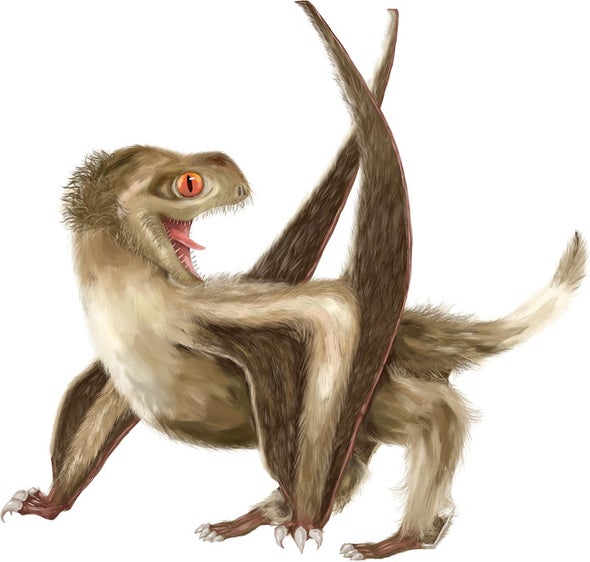
Seems about 247 million years ago, a small lizard sported a display for the ages, something unseen until now, a discovery changing the notion of how reptiles actually looked like back in the day. 


Tuesday, June 03, 2025

Nowhere to go ...


Oh where have the insects gone?, a question more and more people are asking while the collapse of these creatures continues unabated due to pollution, environmental degradation, habitat loss and chemicals, a situation becoming increasingly dire as we speak. Back in the day, yours truly had to clean off the windshield of a beloved VW Camper Bus nearly every 15 minutes due to the flying hordes of insects one encountered in the 70's but no more. As per George Carlin, the earth will survive, us, well, that's another story.


Now a rare sight

Monday, December 02, 2024

Venom


As much as I like Venom and his buddy Eddie Brock, this blurb isn't about this dynamic duo but rather about biological venom and the benefits it has for mankind as nature never disappoints if one looks hard enough
to learn why.


For one researcher, the start point was the Gila Monster.


Gila monsters — sluggish, thick-tailed ground dwellers — are native to southern Arizona and northern Mexico. They have blunt noses and bumpy black skin with tan, pink or orange squiggles. They spend 95 percent of their lives underground. Like their cousins to the south, Mexican beaded lizards, they are one of the very few lizard species that produces venom, which they excrete from mouth glands into grooves in their serrated teeth.

Something's afoot.


Eng recognized the exendins as a potential diabetes therapy. He had patients with the condition who needed to calibrate their insulin injections carefully to avoid both hyper- and hypoglycemia. Exendin-4, on the other hand, resembled a human hormone called GLP-1, which works as a natural insulin manager in people without diabetes. When we eat, the small intestine releases GLP-1, prompting the pancreas to produce more insulin only when blood-sugar levels get too high. The molecule also slows digestion and makes us feel full. Scientists suspected that injections of GLP-1 would be a much easier and safer diabetes treatment than insulin, except for one crucial problem: The hormone lasts only a few minutes in the bloodstream before it breaks down. But the Gila monster analogue, Eng and Raufman were surprised to note, lasts for hours.

Fast forward a few years ...


Patients who took Byetta and other exendin- and GLP-1-inspired drugs also experienced substantial weight loss, trials revealed, but pharmaceutical companies were slow to realize how useful that side effect could be. Once they did, and had improved their formulations, the consequences transformed society: Ozempic and Wegovy, followed by Mounjaro and Zepbound, became blockbuster drugs for treating diabetes and spurring weight loss. What’s more, many of them appear to have additional beneficial impacts that researchers are only beginning to understand. Some seem to be protective against kidney and heart disease and may reduce inflammation in the brain that is linked to the development of Parkinson’s and Alzheimer’s. You might say that the Gila monster — this shy, subterranean reptile — harbored a blueprint all along for medicines that may be among the most consequential health advances of our time.

Venom delivery systems have been around for a very long time. :)


Cone snails, may have the most sophisticated venom in the world.


In closing ...

But in the venoms of creatures that researchers have been able to examine more closely, two features stand out that hint at their significant medical potential. They are incredibly potent and fast-acting — necessary qualities if they are to aid the survival prospects of the creatures deploying them. They can be produced in advance and stored for long periods at ambient temperatures (in the animals’ glands). They are composed of hundreds — or sometimes thousands — of molecules that often serve multiple purposes, making venoms “essentially ecological Swiss Army Knives,” as a 2019 review in the journal Toxins put it. And a majority of those molecules are peptides and proteins honed over millions of years to target other animals in the host’s ecosystem, including plenty of creatures whose biology overlaps that of humans.

Read the long NYTimes piece in its entirety. You'll learn a lot. I know I have. :)

Friday, September 13, 2024

X Marks the Spot


Had fun putting this video together by including different types of footage from drone clips to weather events with asides to insects, music and sculpture.  Enjoy.

Thursday, August 22, 2024

Night Sounds


The night is the best time to hear sounds, whether it be insects tying ther best to survive another night or intense winds issuing forth whenever a fast moving high pressure system makes its presence known. This, plus full moons to illuminate the environment at large, completes the picture as to why nature never disappoints. :)

Thursday, August 15, 2024

The age of extinction ... is here.


Do you remember when your windshield required constant cleaning caused by insects meeting their maker at speed, usually taking on a lime green color as your view of the road became increasingly compromised. Well, I do but not now as in the year 2024, yours truly's windshield remains virgin territory, showing yet again, the age of extinction is upon us thanks to climate change, the 900 lb gorilla promising to change how mankind lives on planet earth in ways differing from any other kind of disaster encountered thus far as said changes are happening in real time, a most disquieting circumstance entirely of our own making.

The Living Planet Report 2022 is a comprehensive study of trends in global biodiversity and the health of the planet. This flagship WWF publication reveals an average decline of 69% in species populations since 1970. While conservation efforts are helping, urgent action is required if we are to reverse nature loss.

To whit

“The staggering rate of decline is a severe warning that the rich biodiversity that sustains all life on our planet is in crisis, putting every species at risk — including us.”

“Across the world, and in the UK, nature is on its knees and our leaders are risking catastrophic consequences for people, planet and our economy by failing to act. We are hurtling towards a hotter planet where nature — and with it, our food, our homes and livelihoods — will be unable to survive without urgent action now to save our climate.”

Download the full report Here.

As we all know, nothing of real consequence is being done as man needs a catastrophe in order to really make change happen. As stated in BRT a while ago, the potential for a true catastrophe centers on India as that nation lies in the epicenter of a wet bulb future.


India experiences temperature/humidity indices in excess of the numbers seen above which means ...

As George Carlin says, it's not the earth's that's in trouble, we are.

Thursday, March 23, 2023

Misalignment ...

Black Eyed Susan

Yours truly takes pictures and videos when walking in woods and fields as my loyal readers know.  While walking, one readily sees the adverse impact of GW ranging from the early blooming of flowers to the dearth of insects needed to pollinate the flowers in question. Other slights include the slow dying of unhealthy trees along with the early arrival of birds, which often proves problematic when the food sources for said birds are not available due to the specter of climate change. The frightening aspect about this is the fact it's just the beginning in terms of what GW means for the continued existence of mankind as nature cannot adapt fast enough to this catastrophe of our own making.

Friday, October 14, 2022

Not just insects ...


It's not just insects ... it's all wildlife as the 6th extinction goes primetime in the year of our lord 2022. The acceleration of GW is not only terrifying, its inevitable as phase transitions are never linear as seen by when a pond freezes over as the day before, said pond is 50% ice free. Nothing of significance is being done to reduce fossil fuel burning as it takes a catastrophe of momental proportions for man to change. For yours truly, a wet bulb event in India, as articulated in The Ministry of the Future, works but one fears it will well before 2050 given just how fast GW is accelerating thanks, in large part, to the loss of albedo in the arctic. 


“Today we face the double, interlinked emergencies of human-induced climate change and the loss of biodiversity, threatening the well-being of current and future generations.”

So begins the executive summary of the Living Planet Report 2022. Released every two years by the World Wildlife Fund (WWF), the study examines global biodiversity and the health of the planet. The latest report reveals an average 69% drop in world vertebrate species in less than 50 years.

We can make a difference but it must happen now.

But there have been some promising discoveries with species that have been recovering.

The population of loggerhead turtle nests grew by 500% on the coast of Chrysochou Bay in Cyprus from 1999 to 2015. Credit conservation efforts that include relocating nests and using cages to protect others from predators. 

Conservation measures have also helped mountain gorillas. In the Virunga Mountains along the northern border of Rwanda, the Democratic Republic of Congo, and Uganda, populations of mountain gorillas increased to 604 animals, up from 480 gorillas in 2010.


Monday, June 06, 2022

Flower Power


May is the prettiest month of the year in CT with flowers everywhere both wild and cultivated, take your pick. Sadly, however, is the fact there are far fewer insects to grace the flowers in question.  Enjoy.

Friday, April 22, 2022

Early Spring

Early Spring's the time earth wakes up. Flowers start to bloom, insects make their presence known, birdsong permeates the air and frogs begin their annual mating dance the moment water warms to the right temperature.

Thursday, April 21, 2022

Insect Apocalypse ... looms


While Americans are the leaders in not worrying about climate change, the rest of the world is not, especially when considering how rapidly the 6th great extinction event, known as the Anthropocene, is gathering speed with one focal point being the ongoing insect collapse happening 24/7 as we speak.


Wednesday, April 20, 2022

Pterosaurs!!!

Artist reconstruction of Tupandactylus imperator. Credit: Bob Nicholls (CC BY)

Of all the animals yours truly would like to see, Pterosaurs top the list. Exotic, mysterious and above all else, spectacularly weird, these ancient flyers top the list in terms of what wonderful mischief nature can come up with to beguile us humans to the max.

Long before the first birds flapped and fluttered, pterosaurs took to the skies. These leathery-winged reptiles, their bodies coated with wispy filaments paleontologists call pycnofibers, were the first vertebrates to truly fly. Now experts are beginning to think pterosaurs and birds had more in common than previously assumed: An exquisitely preserved fossil from Brazil not only hints that pterosaurs’ peculiar filaments may have been true feathers but also suggests that this plumage could possibly have been as riotously colored as that of any modern toucan or tanager.

If both pterosaurs and dinosaurs had feathers, and if those feathers had variable shades for visual communication, then either those traits evolved independently in each branch or they go back to the common ancestors of both groups—reptiles that lived early in the Triassic Period more than 243 million years ago. “We feel that the common structure in dinosaurs and pterosaurs reflects shared ancestry,” McNamara says. Likewise, the findings add support to the hypothesis that some kind of feather or feather precursor was present among these Triassic reptiles, hinting that many more pterosaurs and dinosaurs wore feathery body coverings than paleontologists expected. Pêgas points out that no skin impressions, feathers or other body coverings from Triassic dinosaurs and pterosaurs have yet been found to test this hypothesis. Paleontologists are only just beginning to uncover the deep history of colorful fluff and fuzz, a line of inquiry that will have experts digging into the earliest days of the Age of Reptiles. 

From the tiny to the huge, weird is their middle name.  :)


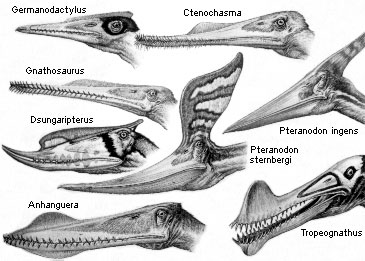
Adaptations of these amazing flyers to their environment goes beyond imagination.

Various pterosaurs


Addendum. The strangest of them all were the Azhdarchid pterosaurs  With wingspans up to 40 feet, as tall as a giraffe and weighing close to 500 lbs, they were the true terrors of the skies without question.


Wonderful mischief indeed.