Showing posts sorted by relevance for query insects. Sort by date Show all posts

Saturday, March 21, 2015

30%+


30% +of all arable land is used to feed or house these guys, along with pigs, chickens and  turkeys, an astounding percentage of earth's resources to say the least, but that's not all.

When emissions from land use and land use change are included, the livestock sector accounts for 9 percent of CO2 deriving from human-related activities, but produces a much larger share of even more harmful greenhouse gases. It generates 65 percent of human-related nitrous oxide, which has 296 times the Global Warming Potential (GWP) of CO2. Most of this comes from manure. 

And it accounts for respectively 37 percent of all human-induced methane (23 times as warming as CO2), which is largely produced by the digestive system of ruminants, and 64 percent of ammonia, which contributes significantly to acid rain.

Livestock now use 30 percent of the earth’s entire land surface, mostly permanent pasture but also including 33 percent of the global arable land used to producing feed for livestock, the report notes. As forests are cleared to create new pastures, it is a major driver of deforestation, especially in Latin America where, for example, some 70 percent of former forests in the Amazon have been turned over to grazing. 

But there is another way.


Entomophagy, a viable alternative for the following reasons.


Two billion people live on insects without issue, something to consider don't you think?

Tuesday, June 03, 2025

Nowhere to go ...


Oh where have the insects gone?, a question more and more people are asking while the collapse of these creatures continues unabated due to pollution, environmental degradation, habitat loss and chemicals, a situation becoming increasingly dire as we speak. Back in the day, yours truly had to clean off the windshield of a beloved VW Camper Bus nearly every 15 minutes due to the flying hordes of insects one encountered in the 70's but no more. As per George Carlin, the earth will survive, us, well, that's another story.


Now a rare sight

Tuesday, October 26, 2021

Sliding into chaos ...


Insect populations are crashing due to the devastating impact of man on planet earth. With this in mind, consider the impact this ongoing loss will have on mankind. Chilling without question.

The same year that Wilson published his article in Scientific American, a group of insect fanciers installed what are known as malaise traps in several nature reserves in Germany. Malaise traps look like tents that have blown over on their sides, and they’re designed to capture virtually anything that flies into them. The group, the Krefeld Entomological Society, was interested in how insects were faring in different types of parks and protected areas. Every summer from then on, society members set out new traps, usually in different preserves. In 2013, they resampled some of the sites they’d originally sampled back in 1989. The contents of the traps were a fraction of what they’d been the first time around.

Over the next three summers, the group members resampled more sites. The results were similar. In 2017, with the help of some outside experts, they published a paper documenting a seventy-five-per-cent decline in “total flying insect biomass” in the areas surveyed. These areas were exactly the sort of habitat fragments that, according to Wilson’s theory, were destined to lose species. Nevertheless, the findings were shocking. In 2019, a second group of researchers published a more rigorous and extensive study, and its findings were even more dire. In the course of just the previous decade, grasslands in Germany had, on average, lost a third of their arthropod species and two-thirds of their arthropod biomass. (Terrestrial arthropods include spiders and centipedes in addition to insects.) In woodlands, the number of arthropod species had dropped by more than a third, and biomass by forty per cent. “This is frightening” is how one of the paper’s authors, Wolfgang Weisser, a biologist at the Technical University of Munich, put it.


A tiny visitor

Insects are, of course, also vital. They’re by far the largest class of animals on Earth, with roughly a million named species and probably four times that many awaiting identification. (Robert May, an Australian scientist who helped develop the field of theoretical ecology, once noted, “To a first approximation, all species are insects.”) They support most terrestrial food chains, serve as the planet’s chief pollinators, and act as crucial decomposers. Goulson quotes Wilson’s observation: “If all mankind were to disappear, the world would regenerate back to the rich state of equilibrium that existed 10,000 years ago. If insects were to vanish, the environment would collapse into chaos.”

Agreed.

Sunday, January 31, 2021

We're losing these guys ...


Striking a pose

We're losing these guys ... from butterflies to bees, the impact of man regarding habitat loss, pollution, poison and over population, for starters, is eliminating insects at record pace, something being replicated all over the world for all life as the 6th great extinction, known as the Anthropogene, is well underway 24/7, a dire situation capable of ending man's reign on earth without exception.

To whit.


Hanging by a thread

Apropos is it not?

Thursday, April 21, 2022

Insect Apocalypse ... looms


While Americans are the leaders in not worrying about climate change, the rest of the world is not, especially when considering how rapidly the 6th great extinction event, known as the Anthropocene, is gathering speed with one focal point being the ongoing insect collapse happening 24/7 as we speak.


Tuesday, November 17, 2009

Brainpower

Every once in a while an article comes out that answers a question I have had in my mind for years. The question: How can insects think with such power when their brain size is miniscule at best? Now I know thanks to a post on Current Biology titled Are Bigger Brains Better?

Attempts to relate brain size to behaviour and cognition have rarely integrated information from insects with that from vertebrates. Many insects, however, demonstrate that highly differentiated motor repertoires, extensive social structures and cognition are possible with very small brains, emphasising that we need to understand the neural circuits, not just the size of brain regions, which underlie these feats. Neural network analyses show that cognitive features found in insects, such as numerosity, attention and categorisation-like processes, may require only very limited neuron numbers. Thus, brain size may have less of a relationship with behavioural repertoire and cognitive capacity than generally assumed, prompting the question of what large brains are for. Larger brains are, at least partly, a consequence of larger neurons that are necessary in large animals due to basic biophysical constraints. They also contain greater replication of neuronal circuits, adding precision to sensory processes, detail to perception, more parallel processing and enlarged storage capacity. Yet, these advantages are unlikely to produce the qualitative shifts in behaviour that are often assumed to accompany increased brain size. Instead, modularity and interconnectivity may be more important.

After reading this amazing piece, one readily understands that efficiency of brain configuration is often of greater consequence than size, something also seen in the extraordinary intelligence of parrots as seen in a earlier BRT post titled Alex, we hardly knew ye.

Not only was Alex smart, (he understood colors, categories and numbers) he also was easily bored if the experiments he participated in were not up to snuff in challenging his intellect.


Seen below is another graphic from the CB writing showing how body mass is a predictor of brain mass in animals.


As follow up, check out Physorg's perceptive take on the CB posting.

Chittka says: "In bigger brains we often don't find more complexity, just an endless repetition of the same neural circuits over and over. This might add detail to remembered images or sounds, but not add any degree of complexity.

To use a computer analogy, bigger brains might in many cases be bigger hard drives, not necessarily better processors."

This must mean that much 'advanced' thinking can actually be done with very limited neuron numbers. Computer modelling shows that even consciousness can be generated with very small neural circuits, which could in theory easily fit into an insect brain.

In fact, the models suggest that counting could be achieved with only a few hundred nerve cells and only a few thousand could be enough to generate consciousness. Engineers hope that this kind of research will lead to smarter computing with the ability to recognise human facial expressions and emotions.


“Machines take me by surprise with great frequency.” - Alan Turing

Thursday, September 19, 2019

Killing me slowly/rev XXX


Biodiversity, you know, having enough flora and fauna to keep earth and us alive, is rather important to sustain unless one is in pursuit of money, an activity proving to be most disquieting in light of the fact 29% of all the birds in America (and Europe) have disappeared since 1969 as articulated in an NYTimes piece Birds Are Vanishing From North America


But insects are in trouble also.


And we haven't even discussed the decline of life in the oceans due to pollution, climate change and overfishing.

Sunday, December 02, 2018

Killing me slowly ...


For the past couple of months, yours truly has tried to focus on the essential terrestrial organisms that, if eliminated from the environment, would cause environmental collapse. With this in mind, insects are prime candidates as they inhabit every continent (including Antarctica's Belgica antarctica, the Antarctic midge) and are intimately involved with all aspects of life on this planet as we know it. Note: We haven't even talked about the sea and land-based microfauna and flora, the baseline lifeforms on which all life on this planet depends. Note II: The oceans are not part of this blurb although it too is under the same amount of manmade stress as well.


Because insects are legion, inconspicuous and hard to meaningfully track, the fear that there might be far fewer than before was more felt than documented. People noticed it by canals or in backyards or under streetlights at night — familiar places that had become unfamiliarly empty. The feeling was so common that entomologists developed a shorthand for it, named for the way many people first began to notice that they weren’t seeing as many bugs. They called it the windshield phenomenon.

When the investigators began planning the study in 2016, they weren’t sure if anyone would sign up. But by the time the nets were ready, a paper by an obscure German entomological society had brought the problem of insect decline into sharp focus. The German study found that, measured simply by weight, the overall abundance of flying insects in German nature reserves had decreased by 75 percent over just 27 years. If you looked at midsummer population peaks, the drop was 82 percent.


Let's think about this while reading Bill McKibben's  in-depth New Yorker article stating the fact earth, in terms of arable use, is shrinking every day due to GW, environmental degradation and resource depletion.

The poorest and most vulnerable will pay the highest price. But already, even in the most affluent areas, many of us hesitate to walk across a grassy meadow because of the proliferation of ticks bearing Lyme disease which have come with the hot weather; we have found ourselves unable to swim off beaches, because jellyfish, which thrive as warming seas kill off other marine life, have taken over the water. The planet’s diameter will remain eight thousand miles, and its surface will still cover two hundred million square miles. But the earth, for humans, has begun to shrink, under our feet and in our minds.

The Anthropocene is gathering speed as we speak.

Killing me slowly indeed.

Sunday, October 30, 2016

10 Months


Watching swifts do a number on insects over an open field is a transcendent experience of seeing how flight becomes magical in a tiny bird that fits in the palm of one hand. What's even more astounding is the fact they can fly for nearly 10 months without touching the ground.


"They feed in the air, they mate in the air, they get nest material in the air," researcher Susanne Ã…kesson from Lund University in Sweden tells National Geographic. "They can land on nest boxes, branches, or houses, but they can't really land on the ground."

The birds' shape contributes to this finding; their "wings are too long and their legs are too short to take off from a flat surface," the magazine reports.

The researchers suggest that one driving force behind the bird's incredibly long flights could be its diet. "[S]pecializing in high-altitude aerial insects as a main food source requires the suite of adaptations for efficient flight shown by swifts, ... which compromises terrestrial locomotion and make swifts vulnerable to predators and parasites had they been landing more often," the paper states.

On a Wing but Nota Prayer :) is a BRT piece on the Frigate Bird, the 2nd greatest flyer in the world.


Friday, October 14, 2022

Not just insects ...


It's not just insects ... it's all wildlife as the 6th extinction goes primetime in the year of our lord 2022. The acceleration of GW is not only terrifying, its inevitable as phase transitions are never linear as seen by when a pond freezes over as the day before, said pond is 50% ice free. Nothing of significance is being done to reduce fossil fuel burning as it takes a catastrophe of momental proportions for man to change. For yours truly, a wet bulb event in India, as articulated in The Ministry of the Future, works but one fears it will well before 2050 given just how fast GW is accelerating thanks, in large part, to the loss of albedo in the arctic. 


“Today we face the double, interlinked emergencies of human-induced climate change and the loss of biodiversity, threatening the well-being of current and future generations.”

So begins the executive summary of the Living Planet Report 2022. Released every two years by the World Wildlife Fund (WWF), the study examines global biodiversity and the health of the planet. The latest report reveals an average 69% drop in world vertebrate species in less than 50 years.

We can make a difference but it must happen now.

But there have been some promising discoveries with species that have been recovering.

The population of loggerhead turtle nests grew by 500% on the coast of Chrysochou Bay in Cyprus from 1999 to 2015. Credit conservation efforts that include relocating nests and using cages to protect others from predators. 

Conservation measures have also helped mountain gorillas. In the Virunga Mountains along the northern border of Rwanda, the Democratic Republic of Congo, and Uganda, populations of mountain gorillas increased to 604 animals, up from 480 gorillas in 2010.


Tuesday, May 11, 2021

Hidden benefits ...

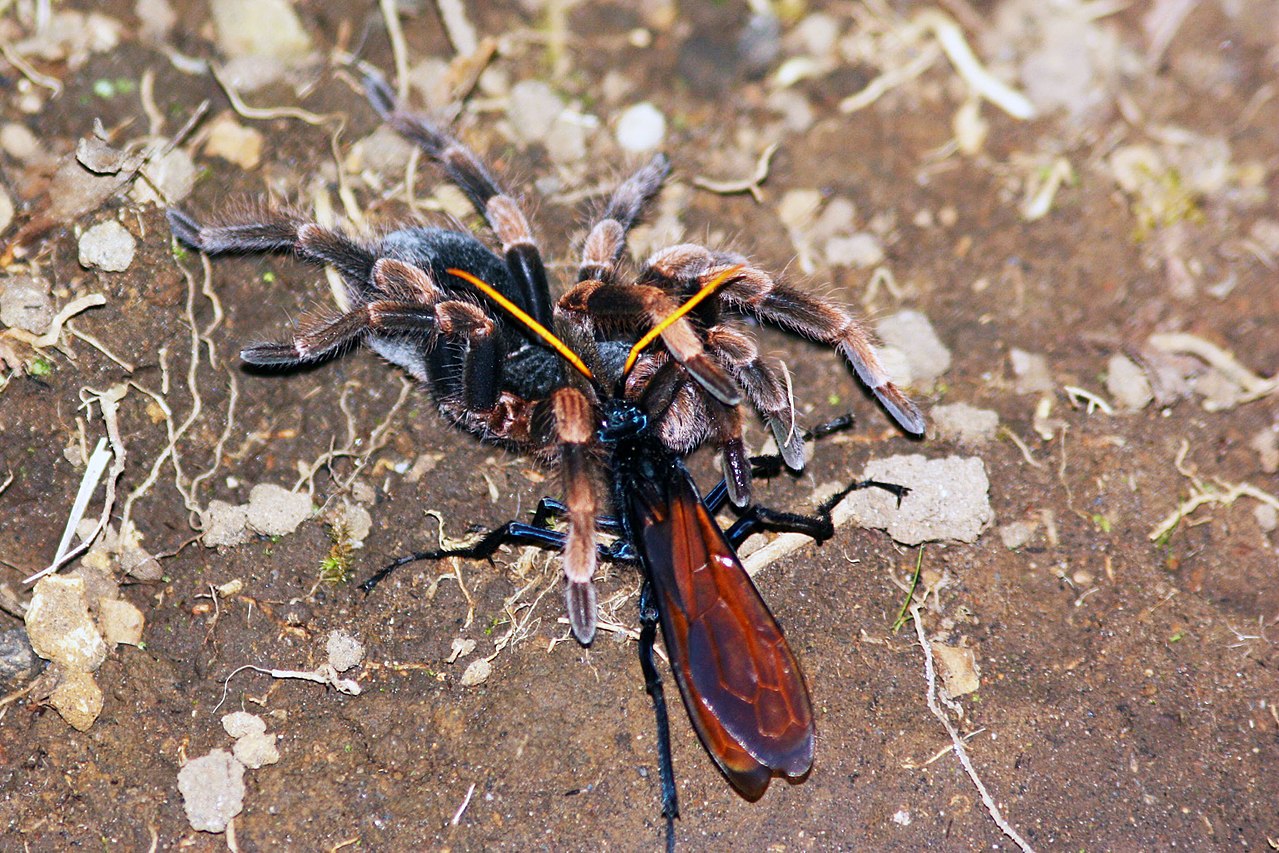
Tarantula hawk dragging a paralysed orange-kneed tarantula, Costa Rica

Wasps, you know, yellow jackets, hornets and the solitaries like the Tarantula hawk seen above, are loathed because they sting but ... there are hidden benefits to these fearsome creatures as they maintain environmental balance by keeping the population of a multitude of pests under control. 

For those who have asked what the point of wasps is, there is now a comprehensive answer. They are voracious predators of pest insects, produce powerful antibiotics in their venom, pollinate plants and even make a nutritious snack.

The benefits to humans of the much-hated insects are revealed in the first major scientific review of the ecosystem services they provide. It focused on the 33,000 known species of hunting wasps, which carry stings and live in every corner of the world.

Yellowjackets and hornets, the picnic pests that have given wasps a bad name, make up a small proportion of all wasp species. But even they provide help that is little known, such as hoovering up caterpillars on vegetable patches. Yellowjacket venom is also being investigated as a promising cancer treatment.

image

The study, published in the journal Biological Reviews, analysed 500 scientific reports on stinging wasps. There are 100,000 known wasp species, but 70,000 are parasitic, which are stingless and quite well studied. They are already used in farming to control pests without using insecticides. There are about 22,000 species of bees. “Wasps are the ancestor of bees, so bees are wasps that have forgotten how to hunt,” said Sumner.

Click here for the PDF of the study.

Monday, November 05, 2007

Sticky Feet

Gecko Tape may have a competitor in Sticky Feet, a reusable, washable tape able to adhere to dusty surfaces without a problem because scientists have finally learned how insects stick to walls.

"researchers call the material “insect tape” because its adhesive properties come from a pattern of microstructures that are inspired by insect feet. The team, composed of evolutionary biomaterials researchers from the Max Planck Institute (MPI) in Stuttgart, Germany, and biologically inspired robotics researchers from Case Western Reserve in Cleveland, US, analyzed more than 300 different species of insects to determine the optimal properties for a man-made adhesive."

Needless to say, this product will sell like crazy if it works as intended and the price point makes the item affordable.

Addendum: I bet Sticky Feet will be one of the monikers manufacturers use when marketing this product, especially if they use an outrageous graphic like the one seen at the top of this article. "Insect Tape" just doesn't cut it in these days of excessive hype and endless sloganeering.

Monday, September 06, 2021

State of Play - Summer 2021


State of Play shows summer's endgame where insects, birds and the environment itself begins the changeover into fall and winter. One has to hunt for insects and birds as there's fewer now along with the fact field grasses are shorter with less variety of plant life to be seen. Hopefully, this clip shows just how beautiful earth is when one takes the time to look. Enjoy.

Friday, June 22, 2012

Links


Being a firm believer in the quantum and the interconnectedness of things, the Physorg post titled
Foundational Concept of Ecology Tested by Experiment peaked this writer's interest as it focuses on the role of invasives in a given environment, a subject delved into at great length for many years by a close friend.


When looking at this, it makes eminent sense as the quantum is connected, where everything is linked to everything else, where probabilities rule along with black swans and, most importantly, why biodiversity must be preserved at all costs if we are to remain a viable species in an increasingly polluted and over populated planet.

Addendum: Elementary school kids did the experiments while researchers tagged along, finding out nature always surprises, without question. :)


Dragonfly larva, a predator supreme

Wednesday, July 08, 2020

Social Distancing ... Lobster style


Seems insects, lobsters, fish, birds and primates socially distance themselves whenever any of their brethren catch a disease threatening their well being, something not being done by a significant portion of the population risking possible death while bitching about losing their inherent freedom to be stupid by not social distancing or wearing a mask while spreading said disease to others as seen in the COVID-19 debacle in the good ole USA.

On a shallow reef in the Florida Keys, a young Caribbean spiny lobster returns from a night of foraging for tasty mollusks and enters its narrow den. Lobsters usually share these rocky crevices, and tonight a new one has wandered in. Something about the newcomer is not right, though. Chemicals in its urine smell different. These substances are produced when a lobster is infected with a contagious virus called Panulirus argus virus 1, and the healthy returning lobster seems alarmed. As hard as it is to find a den like this one, protected from predators, the young animal backs out, into open waters and away from the deadly virus.

The lobster’s response to disease—seen in both field and laboratory experiments—is one we have become all too familiar with this year: social distancing. People’s close interactions with family and friends have been cut off to reduce the spread of COVID-19. It has been extremely hard. And many have questioned the necessity. Yet despite how unnatural it may feel to us, social distancing is very much a part of the natural world. In addition to lobsters, animals as diverse as monkeys, fishes, insects and birds detect and distance themselves from sick members of their species.

Any questions?