Showing posts sorted by relevance for query caveats. Sort by date Show all posts

Monday, June 27, 2022

Toons yet again ...


Agent Orange + One


Dividing lines ...


Statute of limitations


The 9 month window ...


Not quite there yet


Caveats, caveats ...

Monday, June 13, 2022

Sentience?


Sentience? One does not know at this point in time but ... this is the question regarding AI in the year of our lord 2022 as reality's probabilistic and tech never sleeps, especially when analogue is connected to digital in the guise of neural nets, the next big thing in all things related to code and possibly the emergence of true intelligence.


The murmurs keep coming ...


Countering the noise, right?


Caveats ... we don't know how AI works ... 


Thursday, October 16, 2025

Crank ...


I love crank, aka coffee. I admit it, yours truly is a coffee junkie from the get go. I became one thanks to my son who was a barista many years ago and because of that, I continue to this day to be a coffee lover to the max with little side effects save for getting headaches when not getting the fix in the morning but this blurb's not about java, it's about what to do with the grounds. Seems science has an answer and it's a good one. :)


Caveats but not too bad IMHO.


Global demand for sand is increasing, and with it environmental impacts. (Pixabay/Pexels)


Monday, July 11, 2011

The Future of Money... with caveats


As per mashable.com's informative article concerning mobile payment, PayPal may be right regarding the possible demise of the wallet in terms of how we pay for our stuff by 2014 if the article rings true regarding tech, smart-phones and the inevitable fact dollars are now bits able to be decimated to all parties equipped with the right hardware and connects to the web. Caveat: With digital currency, anonymity is but a fiction unlike the physical entity of cash.


PayPal seems to think so. The payments giant boldly predicts that the wallet will be dead by 2015. It’s putting its money where its mouth is: It recently acquired mobile payments provider Zong for $240 million.


PayPal isn’t the only one getting into the game though. Google recently launched Google Wallet, the search giant’s mobile payment system, and Visa recently made a strategic investment in Square, the mobile payments platform now worth more than $1.4 billion.


When reading this article, one player not mentioned is bitcoin, the possible disrupter of all things financial due to the fact there is no trusted 3rd party and it's already working on the net, able to be accessed on all platforms without problems using the free BC plugin. With bitcoin in play, the future of money gets really interesting if you know what I mean. To see BRTs take on BC, click here.

Note: Bitcoin took a quasi hacking hit but it will survive as the tech itself is sound.
"A taste for truth at any cost is a passion which spares nothing." - Albert Camus

Thursday, August 02, 2018

Soft Power ...

The New Silk Road, China's 1+ trillion dollar venture, promises to link a myriad of countries together via high speed rail and roads, is an endeavor that promises, if it succeeds, to transform China into a super power of enormous proportions. With this being said, there are caveats to this grand enterprise according to an excellent Bloomberg article titled China’s Empire of Money is Reshaping Global World Trade Money.
To whit.

What emerges is a picture of mostly poor nations—laggards during the past half-century of global growth—that jumped at the promise of Chinese-financed projects they hoped would help them catch up. And yet as some high-profile ones falter and the cost of their Chinese funding rises, would-be beneficiaries from Hambantota, Sri Lanka, to Piraeus, Greece, are questioning the long-term price. In Malaysia, one of the biggest recipients of Chinese investment in Southeast Asia, newly installed Prime Minister Mahathir Mohamad is pushing back. Expressing concerns about loan conditions and the use of Chinese labor that limit benefits to the local economy, he’s put billions of dollars of Chinese-­funded rail and pipeline projects on hold.

Xi intends a century-long enterprise. China has already outspent the post-World War II U.S. Marshall Plan, measured in today’s dollars. Within a decade, according to Morgan Stanley estimates, China and its local partners will spend as much as $1.3 trillion on railways, roads, ports, and power grids. “Economic clout is diplomacy by other means,” says Nadège Rolland, Washington-based senior fellow for political and security affairs at the National Bureau of Asian Research. “It’s not for today. It’s for mid-21st century China.”

Latin America, venture No. 2.


The percentage of Latin America’s imports from the United States fell from 50 percent of the region’s total imports in 2000 to 33 percent in 2016, while China’s share rose from 3 percent to 18 percent in the same period, according to Inter-American Development Bank (IADB) figures. Latin Americans are increasingly buying more China-made laptops and cars that used to be imported from the United States.

If the United States were to regain the market share in Latin American imports that it had in 2000, it could be exporting around $788 billion a year to the region and would be creating about 1 million additional U.S. jobs, the IADB says.

But while Chinese President Xi Jinping visited Latin America a week after Trump’s inauguration in what was his third visit there in three years, Trump has shown very little interest in the region.

Trump has not only failed to visit Latin America, but has vowed to build a wall on the U.S. southern border and is threatening to withdraw from the North American Free Trade Agreement with Canada and Mexico.

Building a wall is a really good idea, right?

Monday, March 22, 2021

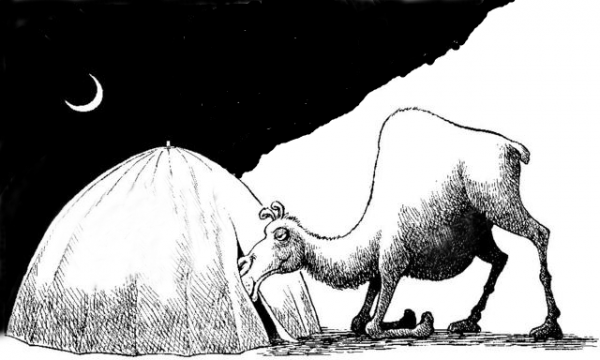
The Camel's nose ...


Years ago, when Lyndon Johnson was president, the problem of dealing with the continued presence of J. Edgar Hoover, the detested head of the FBI back in the day, had to be dealt with. Knowing Hoover kept dossiers on just about every pol in Washington, Johnson decided to keep Hoover in charge using this classic quote as to the reason why Hoover was kept on. "It’s probably better to have him inside the tent pissing out, than outside the tent pissing in." Prudence won the day regarding that miserable human being but the question to ask here is not about Hoover but rather ... is the Camel's nose in the tent the start point for having the entire animal coming inside vis a vis AI and it's increasingly influential relationship regarding the future of dogfights as the military goes further into the 21st century?


Caveats


Skepticism


The Camel's nose indeed.


Saturday, December 14, 2024

Time keeps on slippn, slippn, slippn into the future ...


Android XR looks very promising as seen by this excellent clip as Gemini AI, combined with eyeglasses and smartphone, will transform how man deals with reality in a good way as depicted in a brt piece titled Realtime Translation is Coming but, as we all know, it comes with a cost like everything else thanks to the two laws of thermodynamics. :)

For starters, privacy is totally gone but this time, it's real time. Other caveats include the disparity between the haves and the have not as said tech will cost without question.

Lastly, some skills acquired by taking the time to learn them will atrophy as XR and significant others, will supply all the info needed to cope with the vagaries of the world without have to know anything.

Think cursive or how to drive a stick shift car come to mind here, do they not?

No question I want to use XR when it goes live, do you? :)


Wednesday, January 16, 2019

Caveats


BRT has waxed "poetic" about AI, man's open ended tech merging analog to digital at unprecedented speeds as seen by the rapid advancements of Deep Mind and Watson, among significant others, in their ability to solve complex problems thought to be beyond the realm of AI until now. With this being said, this marriage of analog to digital via neural nets has opened up the era of software designing software due to the fact that in order to evolve, genetic algorithms must be able to adapt to the vagaries of the real world at speeds extending beyond the capabilities of human coders, which means we don't know how this tech actually works. 


A Wicked Problem looms.


There's a mystery afoot ...

In 2015, a research group at Mount Sinai Hospital in New York was inspired to apply deep learning to the hospital’s vast database of patient records. This data set features hundreds of variables on patients, drawn from their test results, doctor visits, and so on. The resulting program, which the researchers named Deep Patient, was trained using data from about 700,000 individuals, and when tested on new records, it proved incredibly good at predicting disease. Without any expert instruction, Deep Patient had discovered patterns hidden in the hospital data that seemed to indicate when people were on the way to a wide range of ailments, including cancer of the liver. There are a lot of methods that are “pretty good” at predicting disease from a patient’s records, says Joel Dudley, who leads the Mount Sinai team. But, he adds, “this was just way better.”

At the same time, Deep Patient is a bit puzzling. It appears to anticipate the onset of psychiatric disorders like schizophrenia surprisingly well. But since schizophrenia is notoriously difficult for physicians to predict, Dudley wondered how this was possible. He still doesn’t know. The new tool offers no clue as to how it does this. If something like Deep Patient is actually going to help doctors, it will ideally give them the rationale for its prediction, to reassure them that it is accurate and to justify, say, a change in the drugs someone is being prescribed. “We can build these models,” Dudley says ruefully, “but we don’t know how they work.”

Questions, questions.

First let us postulate that the computer scientists succeed in developing intelligent machines that can do all things better then human beings can do them. In that case presumably all work will be done by vast, highly organized systems of machines and no human effort will be necessary. Either of two cases might occur. The machines might be permitted to make all of their own decisions without human oversight, or else human control over the machines might be retained.

If the machines are permitted to make all their own decisions, we can't make any conjectures as to the results, because it is impossible to guess how such machines might behave. Theodore Kaczynski

Almost 20 years ago, Bill Joy wrote an essay titled Why the Future doesn't Need Us. a thought provoking piece to the max.

To whit:

Part of the answer certainly lies in our attitude toward the new—in our bias toward instant familiarity and unquestioning acceptance. Accustomed to living with almost routine scientific breakthroughs, we have yet to come to terms with the fact that the most compelling 21st-century technologies—robotics, genetic engineering, and nanotechnology—pose a different threat than the technologies that have come before. Specifically, robots, engineered organisms, and nanobots share a dangerous amplifying factor: They can self-replicate. A bomb is blown up only once—but one bot can become many, and quickly get out of control.

Think about this in terms of autonomous weaponized bots, Musk, Hawking and the military certainly have.

Autonomous weapons select and engage targets without human intervention. They might include, for example, armed quadcopters that can search for and eliminate people meeting certain pre-defined criteria, but do not include cruise missiles or remotely piloted drones for which humans make all targeting decisions. Artificial Intelligence (AI) technology has reached a point where the deployment of such systems is — practically if not legally — feasible within years, not decades, and the stakes are high: autonomous weapons have been described as the third revolution in warfare, after gunpowder and nuclear arms.

Many arguments have been made for and against autonomous weapons, for example that replacing human soldiers by machines is good by reducing casualties for the owner but bad by thereby lowering the threshold for going to battle. The key question for humanity today is whether to start a global AI arms race or to prevent it from starting. If any major military power pushes ahead with AI weapon development, a global arms race is virtually inevitable, and the endpoint of this technological trajectory is obvious: autonomous weapons will become the Kalashnikovs of tomorrow. Unlike nuclear weapons, they require no costly or hard-to-obtain raw materials, so they will become ubiquitous and cheap for all significant military powers to mass-produce. It will only be a matter of time until they appear on the black market and in the hands of terrorists, dictators wishing to better control their populace, warlords wishing to perpetrate ethnic cleansing, etc. Autonomous weapons are ideal for tasks such as assassinations, destabilizing nations, subduing populations and selectively killing a particular ethnic group. We therefore believe that a military AI arms race would not be beneficial for humanity. There are many ways in which AI can make battlefields safer for humans, especially civilians, without creating new tools for killing people.

It's already happening ...


The reality today is that artificial intelligence is leading us toward a new algorithmic warfare battlefield that has no boundaries or borders, may or may not have humans involved, and will be impossible to understand and perhaps control across the human ecosystem in cyberspace, geospace and space (CGS). As a result, the very idea of the weaponization of artificial intelligence, where a weapon system that, once activated across CGS, can select and engage human and non-human targets without further intervention by a human designer or operator, is causing great fear.

The thought of any intelligent machine or machine intelligence to have the ability to perform any projected warfare task without any human involvement and intervention -- using only the interaction of its embedded sensors, computer programming and algorithms in the human environment and ecosystem -- is becoming a reality that cannot be ignored anymore.

Skynet anyone?

What could possibly go wrong?

ROBOT CANNON KILLS 9, WOUNDS 14

We're not used to thinking of them this way. But many advanced military weapons are essentially robotic – picking targets out automatically, slewing into position, and waiting only for a human to pull the trigger. Most of the time. Once in a while, though, these machines start firing mysteriously on their own. The South African National Defence Force "is probing whether a software glitch led to an antiaircraft cannon malfunction that killed nine soldiers and seriously injured 14 others during a shooting exercise on Friday."

Other reports have suggested a computer error might have been to blame. Defence pundit Helmoed-Römer Heitman told the Weekend Argus that if “the cause lay in computer error, the reason for the tragedy might never be found."

In conclusion ...

Facebook Shuts Down AI Robot After It Creates Its Own Language
When English wasn't efficient enough, the robots took matters into their own hands.

Open ended indeed.


Addendum: 

US Navy moves toward unleashing killer robot ships on the world’s oceans

Enter: the rise of the machines.

Boxall’s plan to develop and unleash unmanned killer robot ships is an integral part of the Navy’s new tactics to counter Chinese maritime advancements and, to a more limited extent, those of Russia.

Any questions?