Showing posts sorted by relevance for query NFT. Sort by date Show all posts

Saturday, March 13, 2021

Reducto ad absurdum


A cool 68 mil guarantying access to a digital image defies logic to yours truly, especially when said image, in its totality, can be readily seen in this BRT blurb. Seems NFT's, aka, “a non-fungible token,”, an entity using secure block chain tech to enable one to see work, now has a price tag people are willing to pay for.


IT STARTED WITH CryptoKitties. In December 2017, the dopey-looking cartoon cats, created by Canadian company Dapper Labs, debuted as tradable collectibles, like Pokémon cards for the bitcoin era. Each image was associated with a unique string of digits—a cryptocurrency “non-fungible token,” or NFT—that could be traded on the Ethereum blockchain platform as a title deed granting the holder ownership of a particular kitty.

Ownership via access to bits, right? Taken to the extreme, encrypted bits are now nominally equivalent to written words or compositions of music, thus creating a market of things with no physicality, a notion that didn't exist just three years ago. Question, does the person actually own the art or only access to it, along the lines of code, whereby one does not own the software in question, only the right to use it.

If all of this sounds bizarre, that’s because it is. The idea of paying for the symbolic ownership of a digital image that lives somewhere on the web and can be captured on a screenshot or right-click-download within seconds, is so alien it seems either idiotic or ironic. Yet NFT proponents purport to be solving exactly that problem: the near-impossibility of monetizing digital artworks. “As a mechanism, NFTs make it possible to assign value to digital art, which opens the door to a sea of possibility for a medium that is unbridled by physical limitations,” says Noah Davis, a specialist in postwar and contemporary art at Christie’s.

Sounds like snake oil to me. Question, how much would BRT be worth as said blog has been around for 12 years containing quite a bit of information, something people may pay for if said blog gets encrypted via blockchain tech. Something to consider, right? :)

If it sounds too good to be true, it is.

Addendum


Too good to be true/rev 1.

Tulips crashed in Holland, could this be true for NFTs? One never knows do one? - Fats Waller

Tuesday, December 20, 2022

Quoting Col. Jack Slade ...


Looking at this image says everything about the moral and intellectual bankruptcy of NFTs and the fools that buy this crap. Question, who would want this on their system let alone pay money to "own" said image where one can get it by doing a screen grab like this one. At least when one paid thousands for a tulip in Holland in the 17th century, you got the tulip. In this case, it's photons and truly ugly art.

End of rant for now but many people buy in as seen by the blurb below.


Questionable at best ...

In October, Bloomberg reported that the Securities and Exchange Commission is investigating whether Yuga Labs’s NFTs and associated token, ApeCoin, are unregistered securities. And last June, Yuga Labs sued the artist Ryder Ripps, alleging false designation of origin, false advertising, cybersquatting, trademark infringement, unfair competition, unjust enrichment, conversion, and tortious interference. Ripps had helped spread the conspiracy theory that the Bored Ape Yacht Club’s imagery was laden with racist and Nazi iconography and then launched a rival NFT collection.

Sleaze & then some ...

Alegre will also have to contend with public skepticism of NFTs, and the onset of crypto winter in the last eight months, which had led to a precipitous drop in value for many NFTs, including collections that Yuga owns.

None of the recent turmoil in the crypto market seems to have deterred Yuga Labs’s founders. As Aronow and Solano wrote in their welcome blog to Alegre, “We’re extremely bullish on NFTs and the utility this technology brings in the long term. Yuga Labs will continue to stretch the boundaries of what is possible and keep our community updated on all the cool shit we’re working on along the way.”

In essence ...

Col. Jack Slade: This is such a crock of shit! - Scent of a Woman


The opposite of sleaze is it not?

Tuesday, August 27, 2024

Complexfication ...


Complexification, you know, the ability to bamboozle and confuse the great unwashed, like me, is everywhere. From needlessly complex software interfaces hindering one to do something simple like saving a file to a specific location to encountering blister packs requiring the use of industrial strength scissors to gain access to some gizmo residing inside while avoiding the possibility of getting badly cut in the process makes one crazy to a fault. 

As a designer, yours truly knows, from experience, to never let a coder design a front end to anything.

With this notion in mind, the interesting Wired article , Should art be regulated by the SEC: NFT Artists' New Lawsuit Seeks Answers. brings complexification to a whole new level.

Note, Click here to see BRT's take on NFTs if you dare. :)

In other words, Gottlieb says, it makes an investment contract a security. That can be tricky to apply to art, analog or NFT-affiliated. “When you sell a certificate, what you're really doing is essentially selling art collectors an interest in your art,” Frye says. That means buyers are investing in the expectation “that you're going to get more famous.” That fame, in turn, makes the art more valuable.

If you look at it that way and apply the Howey Test, Gottlieb says, it can look very much like art buyers are investing in a common enterprise and expecting to benefit from the artist’s efforts. The difference, Gottlieb says, is that “artists don’t owe you anything.” You may hope that your purchase of an autographed Brat album will go up in value as Charli XCX keeps selling out concert venues, but that wasn’t promised with the record’s sale. Same, the suit argues, goes for a digital cat cartoon tied to some blockchain-based code.

Sounds rather specious to me.


Monday, April 04, 2022

Horology ...


ho·rol·o·gy
/həˈräləjē/
noun
  1. the study and measurement of time.
    • the art of making clocks and watches.

Exclusive, exceedingly expensive and technologically exotic, watches of this variety are the esoteric toys of the urber rich, wonderful to look at but out of reach for the mortals of the world.

Watches & Wonders 2022 landed this week, and with it the watch industry dropped lab-grown gems, light-sucking cases, and 3D-printed gold.

GENEVA’S WATCHES & Wonders fair, essentially the CES of the watch world, brings together almost 40 of the industry's biggest brands, including Rolex, Patek Philippe, Tudor, and IWC, alongside a sprinkling of smaller, independent marques, to all reveal at once their major launches for the year. It's big business. Despite inevitable Covid-related downturns—particularly in an industry still resistant to ecommerce—in 2021, Swiss watch exports totaled a value of more than $24 billion.


You can't buy this ...

Independent watchmaker H Moser & Cie has the unique license in watchmaking to use Vantablack, the super-black coating that, with 99.965 percent light absorption, is the darkest human-made material on the planet. So far it has produced a number of watches with bewitching Vantablack dials, but at this year's Watches & Wonders it has revealed an entire watch covered in the substance.


The coolest of them all ...

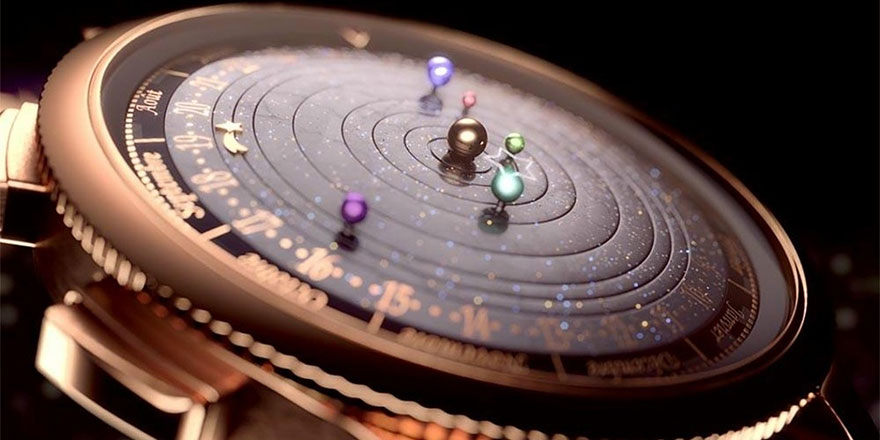
This Astronomical Watch Accurately Shows The Solar System’s Movements On Your Wrist

The Midnight Planétarium watch is an incredible feat of engineering, design and artistic craftsmanship. Besides showing the time, it also accurately displays the movement of six planets in our solar system as they orbit the Sun.

Each of those six planets is represented by a precious or semiprecious stone selected to represent that planet’s color – serpentine for Mercury, chloromelanite for Venus, turquoise for Earth, red jasper for Mars, blue agate for Jupiter and sugilite for Saturn. The two other planets in our solar system were excluded from this astronomical watch because the lengths of their orbits would make their movements on the watch imperceptible and impractical – Uranus orbits the sun in 84 Earth years, and Neptune makes the trip in 164.

Time keeps on slippin', slippin', slippin', Into the future. - Steve Miller Band