Thursday, July 15, 2021

No words needed

NASA's Juno probe has flown closer to Jupiter and its largest moon, Ganymede, than any other spacecraft in more than two decades — and the images it beamed back of the gas giant and its icy orb are breathtaking. 

Juno approached Ganymede on June 7, before making its 34th flyby of Jupiter the following day, traveling from pole to pole in under three hours. 

On Thursday, NASA released an animated series of images captured by the spacecraft's JunoCam imager, providing a "starship captain" point of view of each flyby. They mark the first close-up views of the largest moon in the solar system since the Galileo orbiter last flew past in 2000.

A 'Reichstag moment'


We came close to a 'Reichstag moment'.

Tuesday, July 13, 2021

It's universal


Phase transitions are never linear but they all occur the same way.

For more than 50 years, mathematicians have been searching for a rigorous way to prove that an unusually strong symmetry is universal across physical systems at the mysterious juncture where they’re changing from one state into another. The powerful symmetry, known as conformal invariance, is actually a package of three separate symmetries that are all wrapped up within it.

“This universality result is even more intriguing” because it means that the same patterns emerge regardless of the differences between models of physical systems, said Hugo Duminil-Copin of the Institute of Advanced Scientific Studies (IHES) and the University of Geneva.


Universality indeed.

It's subjective ...

 blocky world map with people

Illustration: Hiroshi Watanabe

We view the world in subjective terms as every human's different as are governments and cultures, something readily seen in differing Google's search engine results generated from various parts of the world depicted by Search Atlas, a powerful new tool showing how subjectivity skews the search in question.
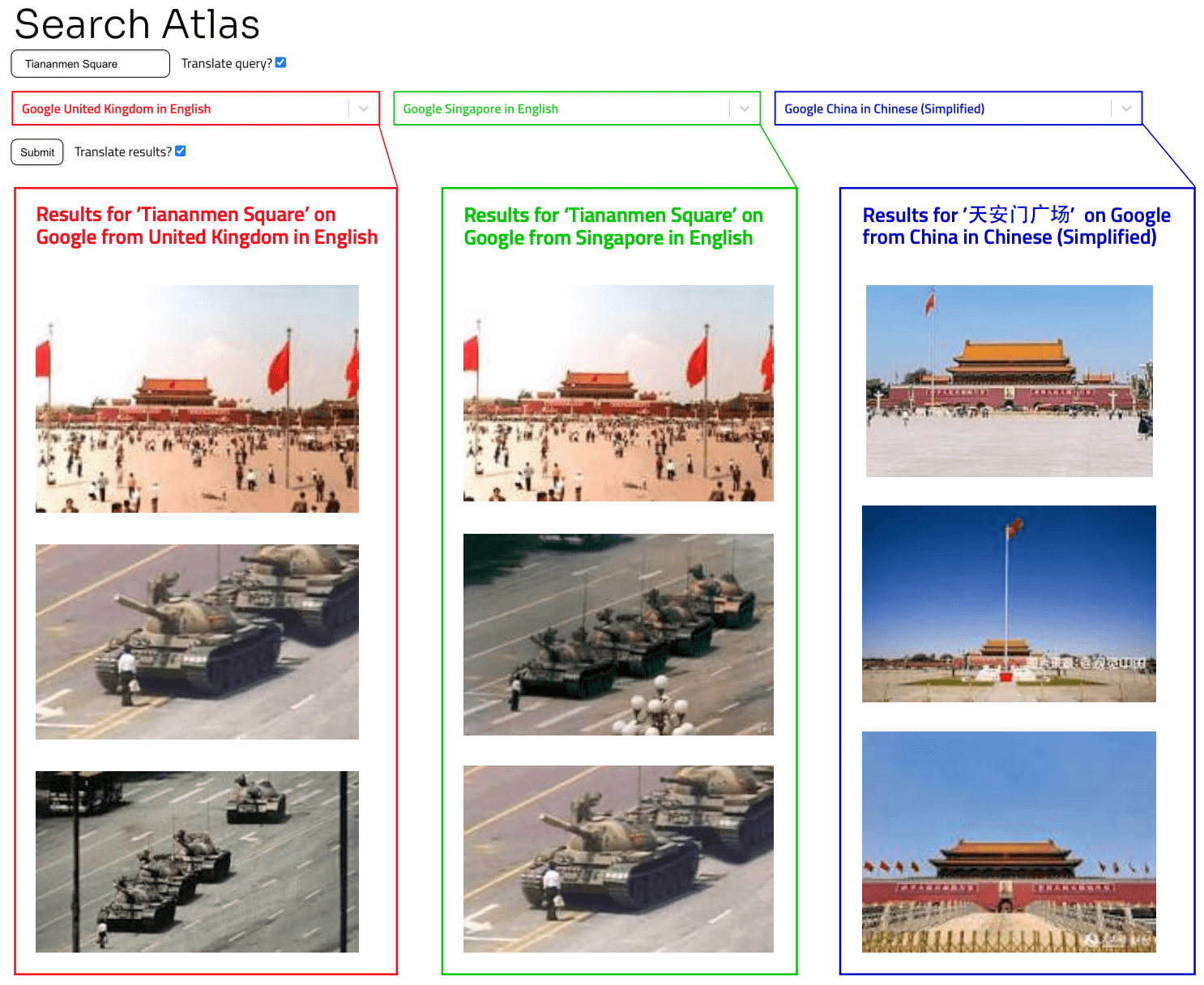
GOOGLE’S CLAIM TO “organize the world’s information and make it universally accessible and useful” has earned it an aura of objectivity. Its dominance in search, and the disappearance of most competitors, make its lists of links appear still more canonical. An experimental new interface for Google Search aims to remove that mantle of neutrality.

Search Atlas makes it easy to see how Google offers different responses to the same query on versions of its search engine offered in different parts of the world. The research project reveals how Google’s service can reflect or amplify cultural differences or government preferences—such as whether Beijing’s Tiananmen Square should be seen first as a sunny tourist attraction or the site of a lethal military crackdown on protesters.

Search Atlas graph showing different search results

An experimental interface for Google Search found that it offered very different views of Beijing's Tiananmen Square to searchers from the UK (left), Singapore (center), and China. Courtesy of Search Atlas

Click the Search Atlas PDF to see why SA's important.

Pareidolia
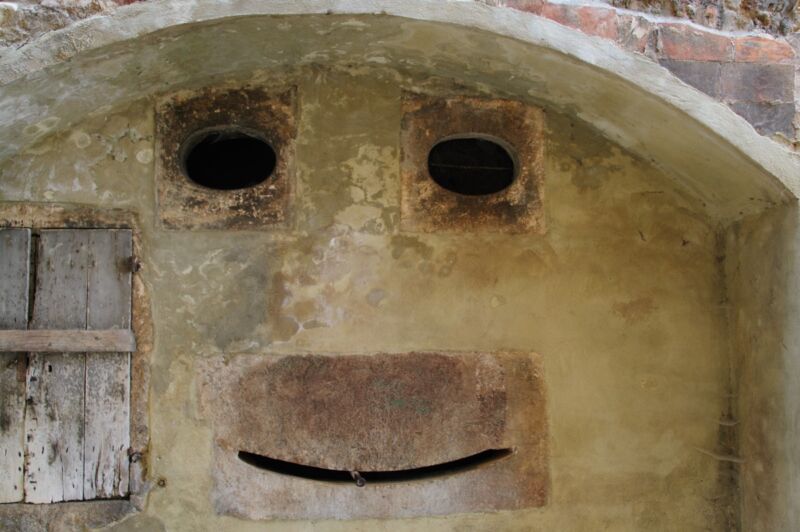
Wall in Tuscany with a smiley face
 

This wall in an old town in Tuscany, Italy, illustrates the phenomenon of facial pareidolia, or seeing faces in things.

We see faces in everything, whether it be clouds in the sky or veggies displaying a face in their greenery. This take is universal and ... we read into these faces the same way we read faces in our fellow humans.

Human beings are champions at spotting patterns, especially faces, in inanimate objects—think of the famous "face on Mars" in images taken by the Viking 1 orbiter in 1976, which is essentially a trick of light and shadow. And people are always spotting what they believe to be the face of Jesus in burnt toast and many other (so many) ordinary foodstuffs. There was even a now-defunct Twitter account devoted to curating images of the "faces in things" phenomenon.

The phenomenon's fancy name is facial pareidolia. Scientists at the University of Sydney have found that, not only do we see faces in everyday objects, our brains even process objects for emotional expression much like we do for real faces rather than discarding the objects as "false" detections. This shared mechanism perhaps evolved as a result of the need to quickly judge whether a person is a friend or foe. The Sydney team described its work in a recent paper published in the journal Proceedings of the Royal Society B.

Do you see yonder cloud that’s almost in shape of a camel? Polonius: By the mass, and ‘tis like a camel, indeed. Hamlet: Methinks it is like a weasel. Polonius: It is backed like a weasel. Hamlet: Or like a whale? Polonius: Very like a whale. - Hamlet/Shakespeare

Pareidolia personified.

Monday, July 12, 2021

AI

Watched Spielberg's Kubrick inspired AI again, a film most provocative, particularly in terms of how David, the AI little boy misreads the emotional nuances of humanity in his never ending quest to love and reunite with his "mother". The scene most powerful to yours truly is at dinner when David laughs, slightly "off" key, along the lines of the uncanny valley, where his laughter is "kinda" right but not. This misread plays out with great power throughout the film along with the inherent uneasiness man has with the specter of AI and what this open ended tech potentially means for the future of mankind.

She loves what you do for her, as my customers love what it is I do for them. But she does not love you David, she cannot love you. You are neither flesh, nor blood. You are not a dog, a cat, or a canary. You were designed and built specific, like the rest of us. And you are alone now only because they tired of you, or replaced you with a younger model, or were displeased with something you said, or broke. They made us too smart, too quick, and too many. We are suffering for the mistakes they made because when the end comes, all that will be left is us. That's why they hate us, and that is why you must stay here, with me. - Giglio Joe. 

There are girls your age that are just like me. We are the guiltless pleasures of the lonely human being. You won't get us pregnant or have us to supper with mommy and daddy. We work under you, we work on you and we work for you. Man made us better at what we do than was ever humanly possible. - Giglio Joe

David:

I like your floor.

Composite 1


Composite 1

If one looks closely, one will see intrusions of different realities placed in a Times Square pix taken by yours truly, a composite piece indirectly referring to the metaverse, an alternate digital reality separate from the analogue version us rubes reside in 24/7.

Sunday, July 11, 2021

Synchronicity


Synchronicity, not the album by the Police, but rather synchronicity generated by fireflies happens when males, wanting to hook up with females, begin the process by sending cascading waves of flashes through a swarm at the point it becomes dense enough for the males to do their thing. 

Swarms of synchronous fireflies are rather like melting ice, or at least that’s how Raphael Sarfati, a physicist, sees it. Ice remains solid until it warms to a certain temperature and becomes a liquid. Likewise, a loose swarm fireflies will flash the lanterns in their abdomens randomly. But when the swarm reaches a certain density, the fireflies begin to blink in unison.

“Above that threshold, it is almost perfect synchronization,” with rhythmic, coordinated waves of light, said Dr. Sarfati, a postdoctoral associate at the University of Colorado, Boulder.

It's not just fireflies ...

The 3-D reconstruction allowed the researchers to characterize several complex patterns in the swarm’s behavior. The male fireflies did not flash instantaneously, but rather in a cascading wave across the swarm. For example, sometimes the flashes would begin at the bottom of the ridge and move toward the insects at the top. This relay-like propagation of flashing suggests that fireflies interact with the swarm locally, taking their cues from the fireflies around them, Dr. Peleg said.

This propagation pattern is also found in other animal swarms such as schools of fish, she added, where local interactions between fish can ripple out to the entire group.

“I see my neighbor is flashing, so I flash as well,” Dr. Sarfati explained.


Fireflies caught in the act in the daytime. :)

Saturday, July 10, 2021

Life ... residing in Enceladus?


Life ... residing in Enceladus? It's possible thanks to Methane, a key ingredient for life found in the plumes of a tiny moon orbiting Saturn.