Friday, September 13, 2019

B&W + 2 ...


Game on ...


Channeling Saturn


D Lion et al


Gradient


Harbor Stage Theatre


Peony + 1


Queen Anne's Lace 

Monday, September 09, 2019

Tilts & Spins


A quick video show spin rates and tilts of our beloved planet that should include Pluto
but does not, for now. :)


Saturday, September 07, 2019

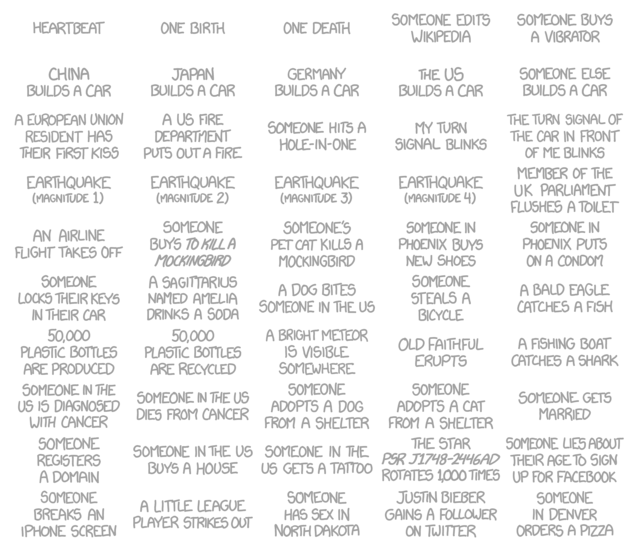
Frequency of ...

Frequency of ... courtesy XKCD. Note, the real deal blinks according to, you guessed it, the frequency of occurrence of said event. :)

Tuesday, September 03, 2019

The underground market ...


A cubic inch of soil contains about 7 billion fungal lifeforms and 1 billion bacteria. The complex interactions of these entities, in conjunction with their plant partners, is akin to a cutthroat marketplace where ruthless supply and demand dictate how zealously guarded resources are to be used by the parties in question is readily seen by the video above and the text below. Enjoy.

Kiers surrounded some nodules on soybean plants with an almost nitrogen-free air supply, making the bacteria in those nodules useless to the plant. She found that the plant reacted by shutting off the supply of oxygen to those bacteria, drastically reducing their reproduction. It seemed the relationship between the bacteria and the soybeans, far from being a happy friendship, was an uneasy détente, with the plant imposing crippling sanctions on any bacterial partners that failed to earn their keep. 

Kiers then switched from bacteria to fungi. While bacteria might nestle into the roots of select groups of plants, fungi are without question the masters of the underground domain. Certain fungi spread through vast areas and commingle with just about every plant they encounter, even sending thready tendrils known as hyphae directly into plants’ roots. (The name for these fungi — “mycorrhizae” — literally fuses the Latin myco-, meaning “of fungi,” with the Greek rhiza, or “root.”) Indeed, the mycorrhizal world forms a sort of inversion of the vegetable one, with branching fungal networks extending downward, mirroring the branching stems and limbs of the plants reaching skyward.

Factoids ...

But what really distinguishes the fungal world is its diversity and complexity. A spoonful of soil contains more microbial individuals than there are humans on Earth. “It’s the most species-dense habitat we have,” said Edith Hammer, a soil ecologist at Lund University in Sweden. A single plant might be swapping molecules with dozens of fungi — each of which might in turn be canoodling with an equal number of plants. It’s a promiscuous party down there.


The underground market ... indeed.

Sunday, September 01, 2019

Unicron ... lives!! :)


Unicron, the Transformer of transformers is alive and well as seen by this clip changing his evil eminence from sphere to character. Enjoy. :)

Introducing the first ever Transformers HASLAB project: Transformers War For Cybertron Unicron.

The Lord of Chaos. The Planet Eater. The Chaos Bringer. Unicron stands alone as the most menacing figure in Transformers lore, capable of devouring entire worlds and civilizations. He debuted in the 1986 film Transformers: The Movie and his insatiable appetite nearly brought the entire universe to its knees.

But his legacy transcends both space and time.

“I have summoned you here for a purpose.” - Unicron

Transformers fans may be mere humans, inhabiting a miniscule planet hardly worth consuming, but they are some of the most passionate fans out there. That’s why HASLAB, the Hasbro Pulse crowdsourcing platform, is the place to awaken such a massive project.

“Then it pleases me to be the first.” - Unicron

My son and I enjoy the original, especially when finding out it was Orsen Well's last professional act as the voice of Unicron. :)


Seems the 2020 version will be somewhat different as seen by this clip.


Methinks my son and I will check this out for old times sake. :)

Beyond pitch-black


Carbon nanotubes rule as they are virtually indestructible, possessing unique characteristics that promise to change how man does business on planet earth. When placed vertically on a substrate, said nanotubes create the ultimate black, reflecting just a tiny bit of light, thus resulting in a visual look akin to a black hole, an effect readily seen by the BMW above and a telescope assembly shown below, ready to be equipped with lenses as needs warrant, both of which are coated with Vantablack, the first commercially available carbon nanotube-based material being used for any application requiring the kind of absolute blackness that only this tech can provide.


Beyond pitch-black indeed.


Here's a video showing the origin and properties of this unique material.


Happy accident indeed.