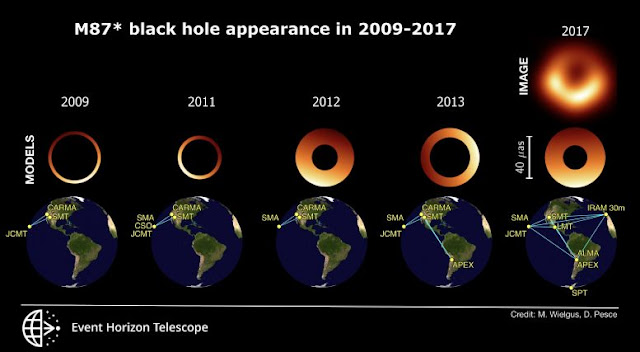
Showing posts sorted by date for query M87. Sort by relevance Show all posts

Thursday, November 12, 2026

But a conjecture ...


But is there a better way in using a 3D approach to do the calc as black holes are 3D constructs, complete with twisted bands of light creating an eerie image of immense power and mystery.

But a conjecture ...

============================================================

  EHT VOLUMETRIC SOLVER — FIRST-PRINCIPLES TOPOLOGY ENGINE

============================================================


[INIT] Connecting to input stream: eht_baseline_subset.dat

[PARSE] Bypassing 2D pixel regularization & statistical smoothing...

[SOLVE] Mapping direct topological mass & photon sphere via CSG/B-Rep...

[SUCCESS] Volumetric geometry resolved in 1.84 seconds.

[COMPILE] Compiling invariant spatial model for local display...


If CSG/B-Rep talks the language of 3D black holes and EHT, images like this may become possible.

Worth a try don't you think?

Friday, June 09, 2023

Rinse & Repeat :)


Yours truly loves quantum mechanics and the two laws of thermodynamics, at lay level of course, as complexity and operating limits apply to the vagaries of reality including black holes, notions one and all brilliantly described in a wonderful Quanta Magazine article provocatively titled In New Paradox, Black Holes Appear to Evade Heat Death.

To whit ...

Heat death held a morbid fascination for Victorian-era physicists. It was an early example of how everyday physics connects to the grandest themes in cosmology. Drop ice cubes into a glass of water, and you create a situation that is out of equilibrium. The ice melts, the liquid chills, and the system reaches a common temperature. Although motion does not cease — water molecules continue to reshuffle themselves — it loses any sense of progress, and the overall distribution of molecular speeds doesn’t change. 

The 19th-century founders of thermodynamics realized that the same goes for the universe as a whole. Once the stars all burn out, whatever is left — gas, dust, stellar corpses, radiation — will come to equilibrium. “The universe from that time forward would be condemned to a state of eternal rest,” Hermann von Helmholtz wrote in 1854. Modern cosmology has not altered this basic picture.

Unless you look closer as quantum jitters apply in the guise of superposition and entanglement.

When an ice cube melts and attains equilibrium with the liquid, physicists usually say the evolution of the system has ended. But it hasn’t — there is life after heat death. Weird and wonderful things continue to happen at the quantum level. “If you really look into a quantum system, the particle distribution might have equilibrated, and the energy distribution might have equilibrated, but there’s still so much more going on beyond that,” said Xie Chen, a theoretical physicist at the California Institute of Technology.


Rinse & Repeat applies :)


Sunday, November 13, 2022

Sagittarius A*


In the center of the Milky Way lurks a fairly quiescent monster, a relatively small supermassive black hole named Sagittarius A*, a tiny entity compared to its much larger cousin, M87. How these engines of creation and destruction work vis a vis the galaxies that house them has perplexed researchers for years but with sophisticated tools such as the Event Horizon Telescope, these objects of fascination and dread are becoming better understood as seen by Knowledgable Magazine's in-depth article titled What the image of the Milky Way’s black hole really shows.


Read the rest of this detailed piece to see how our black hole was imaged if you dare. :)

Wednesday, August 17, 2022

Onions rings at grand scale :)


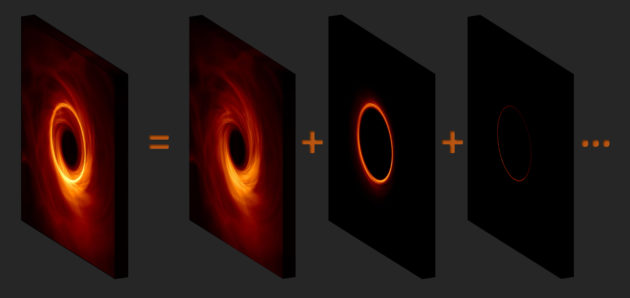
We now are able to see M87 in higher resolution thanks to sophisticated code able to sift through the extensive dataset of the EHT resulting in a photon ring showing the actual outline of M87's super massive black hole. Interestingly, the ring's not a single entity but rather is comprised of many subrings as seen by the image below. 

The M87 image scientists unveiled in 2019 was a landmark, but the researchers felt they could sharpen the image and glean new insights by working smarter, not harder. They applied new software techniques to reconstruct the original 2017 data in search of phenomena that theories and models predicted were lurking beneath the surface. The new, resulting image depicts the photon ring, comprised of a series of increasingly sharp sub-rings, which the team then stacked to get the full image.

the photon ring is the summation of several rings

Supermassive black holes effectively cast a shadow on the light from the hot, glowing gas that surrounds them (leftmost image). Around the shadow lies a bright photon ring. But the photon ring is not a single ring: it’s composed of a series of increasingly sharp subrings. Each subring n is produced by photons that traveled around the black hole n/2 times before reaching the observer (n’s of 0, 1, and 2 shown, left to right). These subrings stack to give the full image.  Michael D. Johnson (CfA) and George Wong (UIUC)

End game.

The result was possible because the EHT is a "computational instrument at its heart," said Broderick, who holds the Delaney Family John Archibald Wheeler Chair at Perimeter. "It is as dependent on algorithms as it is upon steel. Cutting-edge algorithmic developments have allowed us to probe key features of the image while rendering the remainder in the EHT's native resolution."

Click here to read the paper.

Tuesday, May 17, 2022

Identical in every way ...


Einstein's right yet again. Black holes scale in universal fashion thanks to Sagittarius A* black hole proving to be identical to M87*s monster.

One of the leading scientists behind the new breakthrough, Dimitrios Psaltis, professor of astronomy and physics at the University of Arizona, has revealed how the new image proved one of Einstein's predictions from his theory of gravity.

It's all down to the striking similarity between Sgr A* and MH7*, despite their massive difference in size — Sgr A*, which has a mass 4 million times greater than that of our Sun, is more than one thousand times smaller than M87*.

The new image of Sgr A* has proved one of the most fundamental predictions of Einstein's theory of gravity, Psaltis explained in a statement from the University of Arizona. Namely, the new data proves that the image of a black hole scales only with its mass. So, in other words, a black hole 1,000 times smaller in mass will look very similar; the only really discernible difference will be the size. 

Scale invarience rules.

Sunday, May 08, 2022

Data sonification writ large


Converting black hole pressure waves into sound indirectly channels horror films of the 50s with their use of eerie sounds intended to scare the living daylights out of you back in the day. Cool without question. :)


M87's sound is even cooler. :)


Data sonification writ large, rules. :)


Monday, September 28, 2020

Variation 2Step


As suspected, Black Holes wobble a bit. :)


And the beat goes on ...

Thursday, March 19, 2020

Cutting a path ...


Black holes cast a shadow on the image of bright surrounding material because their strong gravitational field can bend and trap light. The shadow is bounded by a bright ring of light, corresponding to photons that pass near the black hole before escaping. The ring is actually a stack of increasingly sharp subrings, and the n-th subring corresponds to photons that orbited the black hole n/2 times before reaching the observer. This animation shows how a black hole image is formed from these subrings and the trajectories of photons that create the image. Credit: Center for Astrophysics, Harvard & Smithsonian

Science has figured out how to get razor-sharp images of black holes, something not even conceived of just one year ago prior to getting the first pix of M87.

Last April, the Event Horizon Telescope (EHT) sparked international excitement when it unveiled the first image of a black hole. Today, a team of researchers have published new calculations that predict a striking and intricate substructure within black hole images from extreme gravitational light bending.

"The image of a black hole actually contains a nested series of rings," explains Michael Johnson of the Center for Astrophysics, Harvard and Smithsonian (CfA). "Each successive ring has about the same diameter but becomes increasingly sharper because its light orbited the black hole more times before reaching the observer. With the current EHT image, we've caught just a glimpse of the full complexity that should emerge in the image of any black hole."

Because black holes trap any photons that cross their event horizon, they cast a shadow on their bright surrounding emission from hot infalling gas. A "photon ring" encircles this shadow, produced from light that is concentrated by the strong gravity near the black hole. This photon ring carries the fingerprint of the black hole—its size and shape encode the mass and rotation or "spin" of the black hole. With the EHT images, black hole researchers have a new tool to study these extraordinary objects.

How cool is that?


Wednesday, April 10, 2019

Just the beginning ...


Black holes rule and ... they exist big time. To whit.


Just the beginning ... of a new era in astronomy is at hand. Stellar without question.

EKCD yet again. :)


Makes one feel small doesn't it?

538's take on how they did this is truly astounding. Excellent to a fault. :)

Just one more thing ... :) The pix below shows the Messier 87 black hole in context
via the Chandra X-ray observatory.


Sunday, October 07, 2018

There be dragons


There be dragons, not only in myth and legend but also in galaxies, entities known as black holes,  the most mysterious object known to science. 


The distance hasn’t stopped astronomers from drawing a fairly accurate map of the heart of the galaxy. We know that if you travel inbound from Earth at the speed of light for about 20,000 years, you’ll encounter the galactic bulge, a peanut-shaped structure thick with stars, some nearly as old as the universe. Several thousand light-years farther in, there’s Sagittarius B2, a cloud a thousand times the size of our solar system containing silicon, ammonia, doses of hydrogen cyanide, at least ten billion billion billion liters of alcohol and dashes of ethyl formate, which tastes like raspberries. Continue inward for another 390 light-years or so and you reach the inner parsec, the bizarro zone within about three light-years of the galactic center. Tubes of frozen lightning called cosmic filaments streak the sky. Bubbles of gas memorialize ancient star explosions. Gravity becomes a foaming sea of riptides. Blue stars that make our sun look like a marble go slingshotting past at millions of miles per hour. Space becomes a bath of radiation; atoms dissolve into a fog of subatomic particles. And near the core, that fog forms a great glowing Frisbee that rotates around a vast dark sphere. This is the supermassive black hole at the core of the Milky Way, the still point of our slowly rotating galaxy. We call it Sagittarius A*, that last bit pronounced “A-star.” The black hole itself is invisible, but it leaves a violent imprint on its environment, pulling surrounding objects into unlikely orbits and annihilating stars and clouds of gas that stray too close. Scientists have long wondered what they would see if they could peer all the way to its edge. They may soon find out.


The incredibly complex quest to see ours requires creativity at the level of an 
Einstein, a Newton or a Hawking, take your pick.


If this works ...


Read this extraordinary NY Times' piece to learn why trying to see our dragon is truly worth the effort.